

Puzzles and D&D go together in an intricate, interwoven dance. Here’s how to stop tripping over your own two feet.
Solving intricate puzzles is a time-honored D&D tradition. So is having your session stall out for five hours as a table full of theoretically nerdy adults faceplants hard into trying to remember what it means that the guard who can only tell lies can’t operate on this man because he’s the guard’s son.
Which is to say, using puzzles in D&D can be pretty tricky. First of all, because you have to figure them out in the first place as a DM. And second of all, because no matter how obvious a thing may seem to you, I can guarantee you’ll be lucky if one other person in the room sees it the same way you do. How do you use puzzles in D&D then? I’m still figuring it out myself, but hey, here are five tips.
Keep It Simple. No. Simpler.
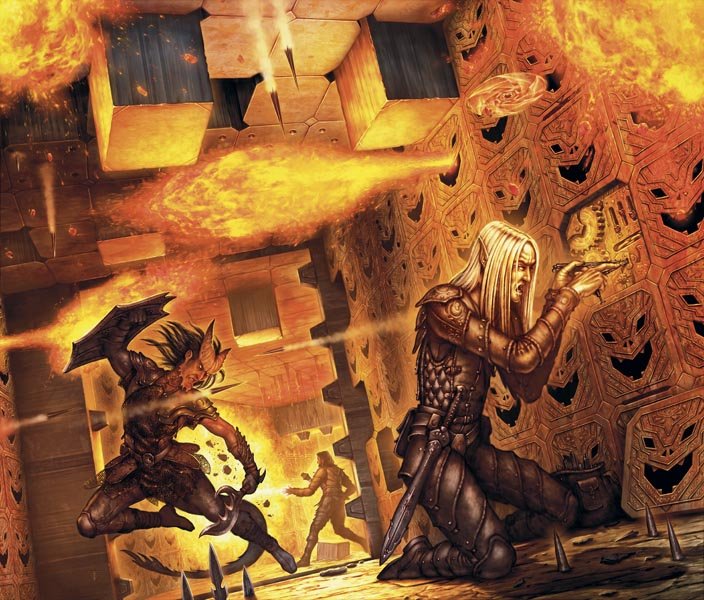
First things first, if you’re anything like me, you’re trying to make it too complicated. Maybe because you think a really clever puzzle will make your players think you’re smart, and then they’ll respect you more as a friend and a person because you showed them what a cool brain you have. And while that would be true in an ideal world, if you’ve read the headlines at all these days, you’ll know we don’t.
But the secret here is that puzzles aren’t about showing off how clever you, the DM, are. It’s about making the players feel clever for figuring it out. You don’t want to make it too simple – people might feel like you’re insulting their intelligence. But in general, you have a puzzle in place because you want players to solve it and figure out whatever answers it’s hiding. So wherever you can, simplify, simplify, simplify. You’d be surprised at what will still be “a challenge.”
You Don’t Have To Know Every Answer
It’s funny. In a typical game of D&D, you’re not expected to know how the PCs are going to win any given fight. Maybe they’ll use their spells in a really clever way. Maybe they’ll go full-on nova in the first round. Or maybe they’ll fight conservatively and save their abilities. Or try that one new magic item they have.
The point is, D&D is a conversation – and you’re not expected to know the only possible way they can defeat an encounter. The same can be true for a puzzle. Sure, you might have a solution in mind, but if you come up with a cool puzzle setup, say some magic gems and an altar, whatever the players try that sounds good, could potentially work! Letting the players come up with their own solution (and then acting like it’s caught you off guard, but yeah, actually that makes sense) is a great way to solve a puzzle that seems stuck.
Feedback Feedback Feedback
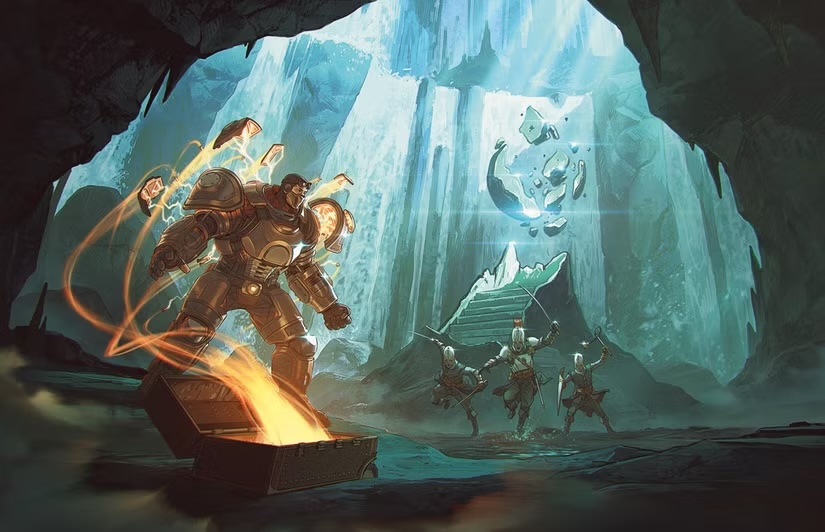
In video games, the secret to a good puzzle is to give feedback so the player knows that what they’re doing matters. And it’s true in D&D as well. It’s just that you, the DM, are the feedback. You have to be the one that describes the crystalline tones that chime as the players start to get the answer right.
Or show how the carvings in the room are changing as the players press the glyphs on the central pedestal, or whatever it is.
Hints Hints Hints
Of course having helpful clues and hints is another great tip to keep the party from getting too stuck. The trick is figuring out how to do that without it feeling like you’re prodding the party along.
I love the “journal of an adventurer who started figuring it out but couldn’t get it in time” found on a nearby corpse. But party members may also be able to summon spirits, commune with nature or the divine, or just have friendly NPCs with them who might be able to point out something the PCs have somehow missed.
When All Else Fails, Skill Checks
When you’ve tried everything else, and you can feel the momentum starting to spiral – don’t forget about skill checks. That’s like 75% of D&D in 5.5E anyway, making the appropriate D20 Test. And sure, maybe this isn’t the most elegant solution, but then D&D isn’t the most elegant game.
That said, you can often use skill checks as a way to reveal more information about the puzzle, or point PCs in the right direction, too. It doesn’t have to be “roll a DC 20 to solve my puzzle”.
What are your best practices for using puzzles in D&D?
Don’t Miss:

Read more at this site