


Rolling for Initiative is a weekly column by Scott Thorne, PhD, owner of Castle Perilous Games & Books in Carbondale, Illinois and instructor in marketing at Southeast Missouri State University. This week, Thorne reflects on how the Fallen Empires release was a pivotal turning point in the early days of Magic: The Gathering.
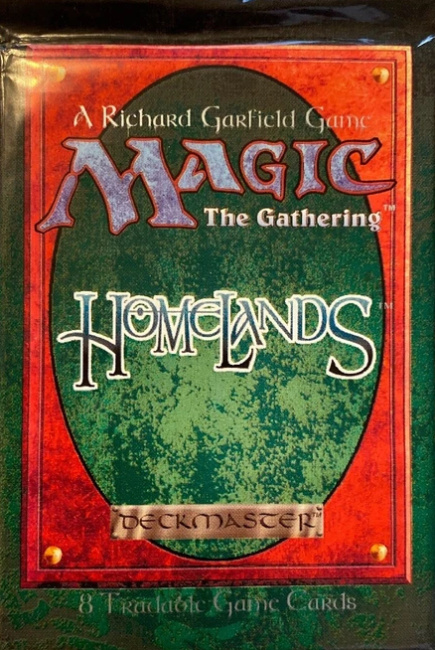
Ah, I remember the Magic: The Gathering Fallen Empires and Homelands sets (see “Worst Early Magic Sets Hit The Auction Block“). Both were experiments by Wizards of the Coast in card allocation in booster packs with different levels of rarity of common and uncommon cards. There were no “rare” cards included in the Homelands set and Fallen Empires had such poor card collation that customers reported purchasing booster packs missing the rare cards. Rare cards missing from packs has happened with other Magic sets, but the frequency has never been as widespread as with the Fallen Empires set. Although they are considered two of the worst Magic sets ever, Fallen Empires especially marked two positive occurrences in the trading card game industry:
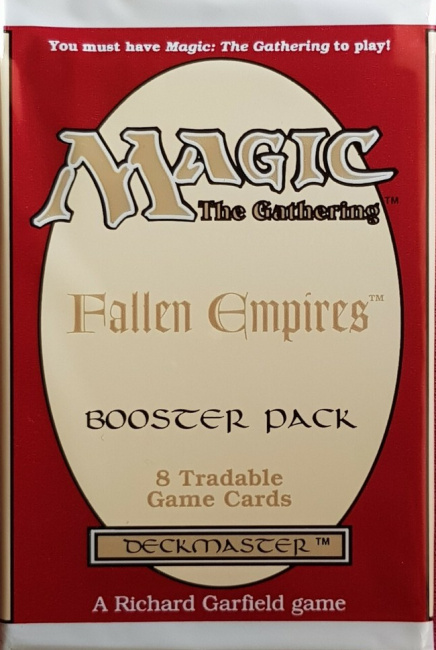
Customer Demand Met. Until Fallen Empires, every Magic set printed had sold out immediately with some customer demand left unmet. Store adopted the practice of putting in ridiculously high orders from multiple distributors, expected to get allocated down, hoping to receive quantities from multiple distributors that would meet the demand at their store.
Stores pressed WotC to increase print runs, use different printers or even experiment with different types of card stock. WotC kept promising the company would print enough of the “next” set to meet demand, but demand kept increasing and stores kept following the inflated order strategy. With Fallen Empires, WotC again told stores to match orders to their expected sales as they would get everything they ordered “this time for sure.” Since WotC had said this with every previous set, stores were understandably dubious.
This time, however, WotC came through with their promise and stores received everything they ordered, putting several undercapitalized ones out of business when they could not pay for the massive quantities received. Since that time, while restocks may still be a little problematic, stores have generally received their initial orders on Magic product without the need to increase orders far beyond expected demand (also, a trend the industry has seen with Pokemon in recent years).
Public Awareness. Demand for Magic grew dramatically from 1993 to 1995, but sales primarily remained confined to game and comic shops. Fallen Empires marked the crossover of Magic from the niche hobby game market to the much wider mass market with more consumer touchpoints opting to stock the game, much as with Pokemon today (I recall seeing a display of Pokemon Surging Sparks at my local Staples last year). Boxes of Fallen Empires boosters appeared next to the cash registers at convenience stores, cafes and even bars. Although that level of market penetration has since faded, it still marked a turning point in the acceptance of trading card games, paving the way for the mass market acceptance of Yu-Gi-Oh! and Pokemon.
Still have boxes of Fallen Empires and Homelands? Send comments to castleperilousgames@gmail.com.
The opinions expressed in this column are solely those of the writer, and do not necessarily reflect the views of the editorial staff of ICv2.com.
Read more at this site