

Kobold Press was founded as a way to goof off and publish what I wanted. The first few years of the company reflect that; it was an outlet while I worked a corporate job to raise enough money to buy a house and raise a family. But I couldn’t stop doing tabletop work, so . . . Evenings and weekends often turned into goofing around with RPG design discussions on the internet. Some things never change.
In March 2006 I’d been running a game design-focused blog on LiveJournal for a while, and I wanted to take some of that theory-crafting and discussion into a more tangible form. The first hurdle was not game design or playtest or editing; it was figuring out a way to acquire art and maps that were a step up from public domain art and Creative Commons. My first attempt at naming was “Customized Adventures.”
On March 19, 2006, I asked the people reading the blog if they’d throw money into the digital hat to hire an artist and a cartographer, and I polled them on what sort of adventure they wanted.
To my surprise, they did (Two backers in the first 24 hours! Three more at the end of a week). The first five years were awesome, if sometimes limited in their scope.
Let’s turn on the Wayback Machine and remember the heady days of Spring 2006.
2006: Founding A Venture
This era of Kobold Press was the “let’s put on a show” DIY hobby gaming at its very best. Folks from the early days, like Ben McFarland, Dan Voyce, Sigfried Trent, Brandon Hodge, Stephen Wark, and many others contributed a few bucks and many comments, votes and insights. The company was very indie, very small, and not at all connected to anything so fanciful as printing presses or sales.
There was writing, playtest, and design in 2006, but not much visible outside message boards where I workshopped, polled, and edited material with a crew of interested game-designers-in-the-making. I also tried to figure out printing and how to fund a book. So far as I can tell, 2006 doesn’t have anything so fancy as “product releases to the public.” It was the hobby year. It was goofing off and trying things.
2007: Periodicals
By March of 2007, things were stumbling along when Dragon Magazine stopped print publication. It was kind of a shock, because Dragon and Dungeon magazines were my first paid work in TTRPGs, and my first jobs in the industry were editing them.
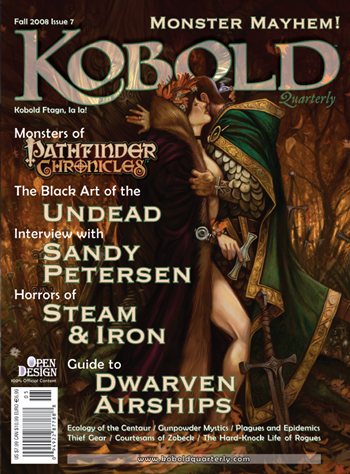
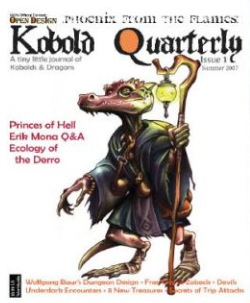
So I launch a tiny ‘zine called Kobold Quarterly to fill the gap. That summer we shipped issue #1, which included an interview with Paizo publisher Erik Mona (king of periodicals for years at both Dragon and then at Paizo with adventure paths). As is tradition in magazine launches, I wrote the editorial and four articles myself, including the first view of the city of Zobeck. This was not sustainable.
Fortunately, others contributed to issue #1: Stan! with cartoons, Sigfried Trent designed expanded rules for tripping attacks, and Scott Gable with the Far Darrig, a monster that has reappeared in many editions of Kobold bestiaries (including Tome of Beasts 1!).
By issue #2, I was awash in brilliant writers who had published in Dragon Magazine and elsewhere. Brilliant art proved harder, but I was learning a lot about secondary rights, public domain, and the power of new artists who wanted to make something cool.
Not a bad year! Kobold Quarterly Issue #1 is still available to this day, as are all 23 issues. Art note: the cover art for KQ #1 was the first appearance of the company mascot, Jiro the kobold, in his current form by artist Darren Calvert. Jiro has become a staple of the Kobold Press look, and he’s had many adventures. And for the magazine, he was just a great cover character.
On a different note, the following April, my accountant told me if I didn’t make any money, I could not write RPGs and minis off as a business expense. Oops. Time to figure out financials! The company incorporated as Open Design LLC in 2007.
2008: All the Firsts You can Imagine
By 2008, the company was putting out physical booklets AND magazines. More than one!
The patronage/crowdfunding approach had funded Steam & Brass, a D&D 3.5 adventure in the Free City of Zobeck in 2007, which was only sent to its backers. Then Kobold Ecologies took the ecologies articles from Kobold Quarterly (and several new ones!), creating an expanded softcover book with about a dozen ecologies. Freelance editor Scott Gable made it shine.
The Zobeck Gazetteer took the non-adventure material I had written for Steam & Brass (48 pages) and made it the first Kobold Press setting available to the public—requests for a setting had been a theme in message boards for a while. I remember the city-first concept was the same as other famous fantasy settings such as Lankhmar, Greyhawk, or Waterdeep: a hub where adventurers meet, quests are given, and (like all righteous cities) wealth is spent on new gear, new hirelings, and new magic. The core of Zobeck is all right there in a compact volume, with cover by artist Malcolm McClinton.
At the same time, I wasn’t writing fast enough to meet demand, so I decided to take all the essays on design I had been writing for patrons and expand on them in a printed edition. This was The KOBOLD Guide to Game Design, Vol. 1, with essays by Keith Baker, Nicolas Logue, Ed Greenwood, and yours truly. The series went on to Volume 2 and Volume 3, but this was the start of the Kobold Guides series that won so many awards over the years—the same series is coming to hardcover this year, by the way.
The other big win of the year was the Diana Jones Award for patronage, the business model we now call crowdfunding. The award was shared with Grey Ranks by Jason Morningstar, an amazing indie game about resisting fascism during the 1944 Warsaw Uprising (ask me about my family’s Polish history).
Hard to say that the year could have been any stronger!
2009: Awards
At this point, the company was doing 4 magazines a year, patronage projects, and KOBOLD Guides, though it was all still in either PDF only or black and white softcover. We commissioned a cover by David Wenzel for Dwarves of the Ironcrags, the second of the Gazetteer series that became the core of the Midgard setting. The cartographer was the amazing Jonathan Roberts, who went on to draw the official maps of Westeros for the George RR Martin Game of Thrones series.
This was also the year Kobold won a Silver Ennie award for Tales of Zobeck, a D&D 3.5 adventure collection by Ed Greenwood, Dan Voyce, Ben McFarland, Tim & Eileen Connors, and many others. I think this was the first patron-funded project made available to the public, though only in PDF form. (As I remember it, the print edition was backer-only.)
One item from 2009 that I’m very proud of as a contribution to the history of TTRPGs, is the last interview with D&D co-creator Dave Arneson, conducted by Jeremy Jones. Originally published in Kobold Quarterly #9, this interview is still available for free on this site in both English and in Spanish translation. It revealed, among other things, a connection to German models and minis that made my Teutonic heart proud.
Anno Domini 2009 is also the year that Kickstarter was founded, though Kobold Press still ran its crowdfunding efforts using its own direct funding system.
2010: Zeb Cook and the Aboleth
In 2009, the company was COOKING. The quarterly magazines were driving visibility in hobby stores and with subscribers, and Kobold Quarterly got us noticed by people like Paizo Publishing (periodicals to the core!) who put Kobold Press items into the Paizo Store and enabled the company’s first efforts at hobby distribution.
The biggest release of this year was Sunken Empires, which first brought forward the lore of lore Ankeshel by designer Brandon Hodge, with a section called, “How to Sink a Continent.”
And crucially, Sunken Empires includes the history of the aboleths by their inventor, David “Zeb” Cook, the creator of 2nd Edition AD&D, Planescape, the Isle of Dread, the D&D Expert Set, and many, many others, including as a content designer at Elder Scrolls Online.
Having the deep lore of the aboleths spelled out by their inventor was a moment where Kobold Press took a step toward making monsters a centerpiece. It was also a moment where the conversation about high fantasy got a bit richer. If Kobold Press could publish lore about a creature as central to Dungeons & Dragons as the aboleth, well, the sky was the limit. More of this came later, in bestiary form . . .
The dark horse that showed up in Kobold Quarterly #9 was a new writer named Marc Radle, with an article called The Spell-Less Ranger. It was a great new take on the Pathfinder ranger, and it was stupidly popular. As part of the strong Pathfinder RPG framework that Kobold Press supported during this period, this variant class helped launch of many others in a series called New Paths.
The preview for the 2018 New Paths hardcover compilation is still live at Paizo. That New Paths foundation includes concepts and refined versions of classes that are still part of the Kobold Press DNA today, such as the theurge, the witch, and others found in Deep Magic for 5th Edition D&D and in Player’s Guide 2 for the Tales of the Valiant RPG.
2011: Kickstarter at Last
Five years in, the company took the plunge into a new platform for the crowdfunding we’d been doing for years, and that new platform took the company to the next level.
Yes, Kobold Press finally adopted Kickstarter, with Journeys to the West, a major seafaring adventure and rules supplement by Ben McFarland, Christina Stiles, Jim Groves, Brian Suskind, Ted Reed, and others covering everything nautical in December 2011. With the first Kobold Press cover by artist Craig J. Spearing, it raised $15,000 for a softcover title, which isn’t bad! We could afford new maps and a snazzy painted cover! There was also a PDF special item called Bosun’s Booty that didn’t ship until 2014!
You can see the proof here: the First Kobold Kickstarter!
All that history is good, and not much of it appears in the Kobold Press Wikipedia article. (Hint: someone update that thing with anything from the last 5 years, please!).
The Next Five Years Next Week
It’s been fun reminiscing about the very early days, when there was no money made, everyone had day jobs, and no one could afford a hardcover book.
It’s true! The first Kobold Press hardcover did not appear until 2012! But that’s a story for next week. 2012 is also when Kobold Press hired our art director, Marc Radle. Let’s ask him if he remembers anything about 2012 to 2016 . . .
I’d love more shared memories from this early period in the comments, because it’s all been a few years—if you were there in 2006 to 2011, please weigh in in the comments her or in our Discord.
Read more at this site