
You’re new to D&D and you’ve seen some stuff on the Internet, but it’s kind of a lot.
Lots of big words. Lots of abbreviations. Lots of expecting you to know what’s already in the Player’s Handbook.
We’re going to clear some of that up with a list of terms you need to know to play the game.
Outside the Game
Here are some terms people use when they’re not playing the game, but talking about the game.
5E. This stands for fifth edition, the current version of the game. (It’s actually on 5.5 now, because they just did a refresh of the rules, but the changes are pretty minor, and 5E is still the standard name for it.)
4E, 3E, etc. Previous editions of the game, which ARE pretty different! The game has gone through a lot of changes in 50 years.
d20. The “d” here stands for “die” and the 20 stands for, uh, 20. It means a 20-sided die. All the other dice have the same kind of names: d4, d6, d8 . . . you get the shape of it.
D&D. Dungeons & Dragons. The name of the game.
D&D Beyond. This is the online subscription service run by Wizards of the Coast that gives people access to an electronic version of the game.
DM. Dungeon master. The person who leads the game.
GM. Game master. Means the same thing as dungeon master, but since Wizards of the Coast has trademarked that term, other games use “GM” to mean the same thing.
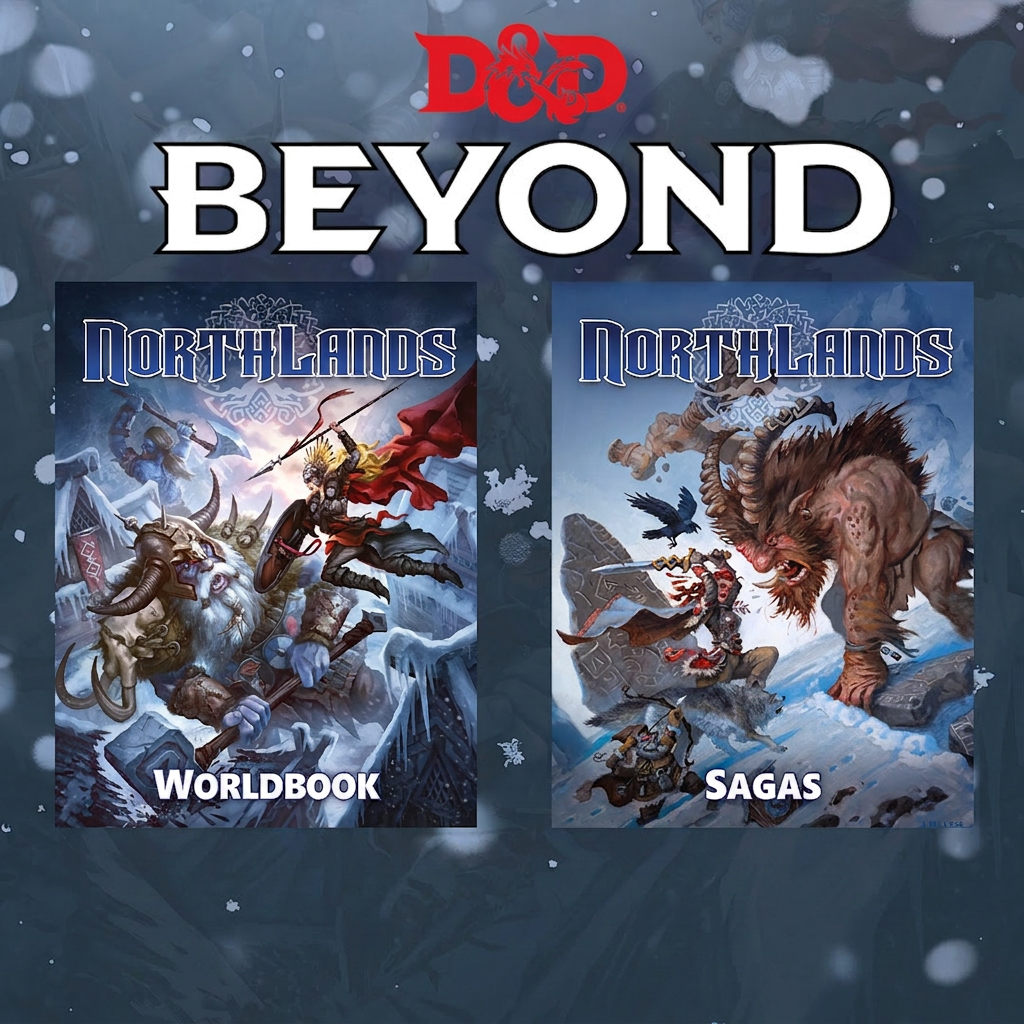
Now on D&D Beyond: NORTHLANDS!
Take your adventure to the frozen North to battle giants and sail longboats in search of treasure!
Inside the Game
These terms are used when you’re playing the game.
Ability scores. Sometimes just called “abilities”, these are the big six that describe a character’s basic capacity.
- STR – Strength
- DEX – Dexterity
- CON – Constitution
- INT – Intelligence
- WIS – Wisdom
- CHA – Charisma
AC. This stands for armor class. In a fight, this is a measure of hard it is to hurt a character with swords and stuff.
Class. This is your character’s job. Bard, Fighter, Wizard . . . it’s what your character does.
CR. This is challenge rating, a number that tells you how tough a monster is. It’s kind of like level for a monster.
DC. This stands for difficulty class. This is how hard it is to do a thing. It’s like armor class, but for every other think you could try.
HP. This stands for hit points. Every time your character is damaged they take some hit points, which are subtracted from your current hit point total. When you’re at 0 HP, your character risks dying.
Level. This number tells you how powerful your character is. It goes from 1 to 20. The higher the number, the more powerful your character is.
NPC. This stands for nonplayer character, which is all the characters that arent’ played by individual players. The game master plays them, as people the player characters can talk to.
PC. This stands for player character, which are the characters that players play, generally one per player. Your barbarians and sorcerers, elves and halflings.
Subclass. Once a PC reaches level 3, they get a subclass which lets them specialize a little bit.
XP. This stands for experience points, which are given by the GM to your PC when they overcome challenges. Get enough XP, and your character goes up a level.
Other Terms Used in Play
cp, sp, gp, pp. These are the various coins adventurers find, spend, and hoard. C = copper, S = silver, G = gold, P = platinum. “gp” is the one used most often. It’s kind of the “dollar” of most fantasy worlds.
Language. Different fantasy creatures speak different languages. Common is the “standard” language nearly everyone speaks. Many species have their own languages (such as Elven and Dwarven). Some monstrous creatures speak their own languages too (such as Giant and Infernal).
Size Categories. Creatures in a fantasy game have lots of different sizes, and being bigger or smaller comes with some bonuses and penalties. The sizes form smallest to largest are: Tiny, Small, Medium, Large, Huge, and Gargantuan. (If you get them mixed up, you can remember that the order is reverse alphabetical.)
Skills. Most actions your character can take fall into categories covered by skills. If your character is proficient in a skill, they get a bonus when they roll to see if they succeed at it.
There are many other terms in the game, but these should get you started.
Did we miss anything? Let us know in the comments or over on the official Kobold Press Discord!
The post What do all these D&D words mean? – May 27, 2026 appeared first on Kobold Press.
Read more at this site