

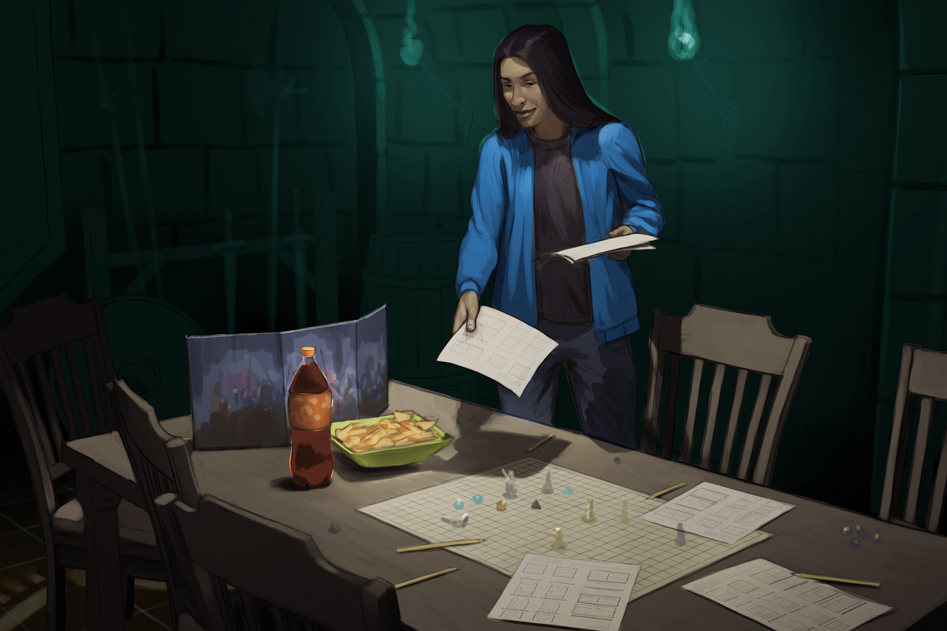
You’ve decided you want to try to be a GM in the new year. YES. Great choice. We’re here to support you in that journey! The Kobold Press game of choice is the Tales of the Valiant (ToV) RPG. It’s completely compatible with D&D (both 2014 and 2024), so you could jump between the games easily or even mix and match from both.
Tales of the Valiant Quick Intro
ToV has two core books: Player’s Guide and Monster Vault. The Player’s Guide includes rules for 13 heroic base classes, lineages including elves and dwarves, and more from classic fantasy roleplaying. It has all the rules for being a player or GM in one volume. The Monster Vault includes more than 400 dungeon-crawling fantasy creatures any GM needs to craft compelling encounters.
Both are available, along with the Game Master’s Guide and the beginning adventure, The Impregnable Fortress of Dib, for one low price on Humble Bundle right now. That’s not even everything in the bundle. It’s an amazing value!
Get the Tales of the Valiant RPG Bundle from now until January 7, 2026!
It’s a great time to get into ToV! Get the Player’s Guide, Monster Vault, Game Master’s Guide, Adventures of Dib (the adventure we’re working with in this series) and more, all for one low price!
Light Reading
As a savvy, in-tune gamer, you know that January is New Gamaster Month. It starts tomorrow officially, but here’s the get-ready page.
If you want to get even READIER, review this primer from last year’s New Gamemaster Month articles for the Tales of the Valiant RPG.
If you have your ToV Player’s Guide (and there’s still a couple more days to get it at Bundle of Holding for cheap, cheap, cheap!), begin by reading these pages:
- Chapter 6: Encounter Game Play, pgs. 221–224
- Chapter 6: Combat Encounters, pgs. 225–235
- Chapter 7: Spellcasting, pgs. 239–245
Painting the Picture
So, you’ve readImpregnable Fortress of Dib. Today, we’ll look at it again with an emphasis on how to portray locations, nonplayer characters (NPCs), and encounters.
Doing this thinking in advance helps plant important details in your mind when the game is live and there are fifty other things to think about.
LOCATIONS
As the game master (GM), you act as a narrator moving through the adventure. If you have a complete picture of the scene, you can help give it to your players too.
A good practice is to consider the five senses every time characters enter a new location:
- What do they see?
- What do they hear?
- What do they taste?
- What do they feel?
- What do they smell?
This approach provides a strong foundation for your descriptions and delivers subtle information to the players. It can also prompt story-based rolls. For example, a WIS (Perception) check can reveal more than what a character initially sees. The Impregnable Fortress of Dib mentions that the moat around Dib’s fort is a “noxious stench.” Is that because it’s filled with putrid trash, bodies, or something worse?
Setting the tone engages your players and helps them immerse themselves in the game. Consider these questions: Is it dusk? What color is the sky? What sounds and flora are found in the Blind Hills? Do travelers often use this road? Can you smell Dib’s hot oil or hear the chatter of goblins from inside his fortress? How does the atmosphere shift as they approach? The more sensory details you communicate, the more players have hooks to participate.
Spend 3 to 4 minutes per encounter imagining what it might feel like. It’s fine to jot down notes if inspiration strikes you, but don’t go overboard. Your players will likely approach the encounter differently than you envision, so avoid committing to a specific outcome. However, a detailed, atmospheric idea in your head allows you to bring encounters to life, enabling your players to take action and build on the story you started.
NPCs
NPCs are the domain of the GM. It is crucial to understand who they are and their purpose in the story. Visualize them clearly in your mind; give them distinctive voices, quirks, and behavioral tics. Make brief notes for yourself as a GM to ensure you don’t forget these details during the game, but if you miss them or forget in the moment, it’s fine. You can add them later or do something different. The players will never know!
Impregnable Fortress of Dib is light on NPCs, but the introduction narrative is told from the perspective of someone who “traveled the old trad road up near Blind Hills” and witnessed Dib’s wagon in the ditch. Consider who this person is and when in the story they’ll relay this information. And don’t forget Dib himself! He’s the “boss” of the adventure, so maybe practice a voice or catchphrase to make him distinctive and worthy of all the player characters’ (PCs) effort.
ENCOUNTERS & MONSTERS
Next, take some time to examine the combat encounters in the adventure. The attack on Dib’s fortress is a significant part of the adventure. The adventure details special attacks the goblins can make while inside the fortress and highlights the differences between encounters underground and those outside the wagon.
If the PCs encounter any goblins, you can refer to the free stat blocks available at BFRD.NET:
The purpose of this review is twofold: first, it helps you understand the stats, preparing you for the creatures’ capabilities and likely tactics. Second, it encourages you to think about the goblins—how do you describe them? Do they use good tactics or rush aggressively at the characters? What sounds, smells, or visual details come to mind? Visualizing these aspects allows you to present an engaging and vivid experience to your players.
Feel free to share your ideas on the Kobold Press Discord—you might find inspiration there as well!
Read more at this site