

TSR Inc. published Dragon #104 in December 1985. It is 104 pages long and has a cover price of $3.00. This issue features thieves, the ochre jelly, and a Marvel Super Heroes adventure!
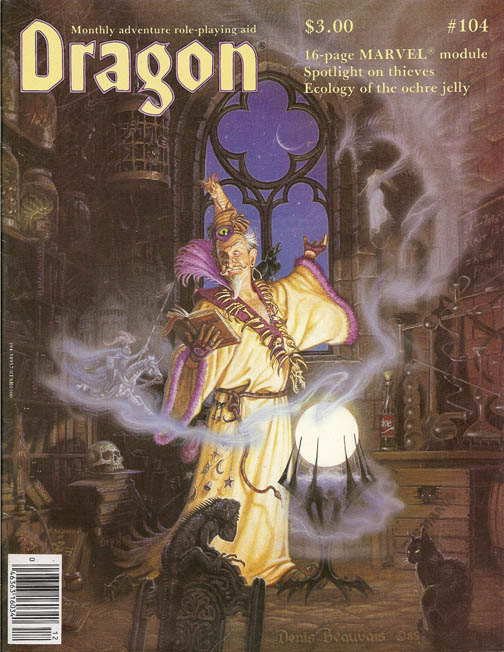
The cover, “Spinning Tales”, is by Denis Beauvais and depicts a wizard with a unique method of storytelling. It’s another very memorable Beauvais painting. Interior artists include Jeff Busch, Bob Walters, Jim Roslof, Roger Raupp, Timothy Truman, the Marvel Bullpen, David Trampier, Richard Tomasic, Joseph Pillsbury, and Larry Elmore.
This month’s special attraction is “Sudden Dawn,” a Marvel Super Heroes module by William Tracy. It is 1944, and the evil Baron Blood plans to steal intelligence from the Manhattan Project and construct an atomic bomb. It is up to the Liberty Legion, led by Patriot, to stop him. The module is split into four chapters, each one centred around a battle. The adventure is very much a railroad, with character decisions having little impact on the flow of events. Instead, in each chapter, the army tells you where to go and what to guard or attack. I was struck by how cheesy some elements were (e.g. a villain named “Warrior Woman”), though that reflects the comic book source material. Those caveats noted, it looks like a fun story to play through. Tracy was a versatile RPG freelancer with credits across numerous systems.
This issue contains a three-feature special called “The rogues of role-playing,” focusing on thieves. “Was it worth the risk?” by Bruce Barber provides expanded rules for pickpocketing, including a nifty d100 table of pocket contents. Such tables are common now, but were wonderful back in the day. Barber published a handful of articles with Dragon.
“The well-rounded thief” proposes five types of thieves, depending on their motivation: greedy, professional, avenger, artist, and recreational. It offers a simple and useful extra dimension to character creation and is the sort of gaming article I like best. “Race is ahead of class” almost contradicts the prior article by suggesting racial attitudes will determine the type of thief you are: elves are secret-seekers, half-orcs are robbers, etc. Not an idea that will get much support today! John Bunnell, a prolific Dragon contributor, wrote both of these articles.
There are two “reviews” of new TSR products, though they are really advertorials. Oriental Adventures “has something for every DM and player,” while X10: Red Arrow, Black Shield shows you “how to build a world at war.” They are disappointing articles, and I’d even call them puff pieces. Obviously, TSR is going to use the magazine to promote its own products, but I prefer the approach where an editor interviews the creator about their new book—it feels a bit more honest.
“Meeting of the Minds” by Peter Zelinski expands the psionic encounter table from the Dungeon Masters Guide to include new monsters from the Fiend Folio and Monster Manual II. It’s a prosaic piece. Zelenski’s only other published credit was an entry in “Creature Catalog III,” in Dragon #101.
Len Lakofka returns with a new instalment of “Leomund’s Tiny Hut,” the column’s first new entry in two years. He has analysed the weapon specialisation rules in Unearthed Arcana and concluded that they make martial classes much more powerful. He suggests preserving game balance by beefing up opponents or toning down the specialisation bonus. Lakofka was head of the International Federation of Wargamers.
“The ecology of the Ochre Jelly” by Ed Greenwood details one of the classic D&D monsters, dating back to the original edition. The article starts with a typical framing device, as Elminster describes how a Cormyrean soldier used an ochre jelly to stop a brigand incursion. The rest of the text details the characteristics of these creatures: amorphous, non-intelligent, able to detect vibrations and so on. There’s a slight departure in format from previous columns—the section with game mechanical information is not numbered this time. A solid article, but with less fresh insight than I’ve come to expect from Greenwood.
“Assessing, not guessing,” by Lionel D. Smith, presents a subsystem that enables your character to estimate the worth of a valuable item, with their success influenced by class, race, and secondary skills. It is a coherent approach, but I’m sure it could be simplified. This was Smith’s only published article.
“Spy’s advice” by Merle M. Rasmussen answers reader questions about Top Secret. Examples include, “When a car is fired upon, how do you determine where the bullets strike the vehicle?” and “Does an increase in Charm increase the Deception as well?” TSR and Dragon were still providing plenty of support for this game.
One feature I missed in the last issue was the new “Staff Profiles” column, which offers brief sketches of TSR’s creative team. After opening with Gary Gygax, the column now turns to Harold Johnson, head of game design, and Zeb Cook, senior game designer. These columns are a treasure trove for those interested in the game’s history.
Finally, the ARES Section is back, presenting about a dozen pages of science-fiction and superhero gaming material. It includes five articles:
- “Star Law Returns” by Matt Bandy shares variant rules for the interstellar police in Star Frontiers.
- “Hexes and High Guard” by Jefferson P. Swycaffer revises space combat for Traveller.
- “The Exterminator” by John P. Mau and Brian Shuler presents a nasty encounter for Gamma World.
- “The Kzinti Have Landed!” by Jon Slobins introduces Kzinti characters for Star Trek.
- “The Marvel-Phile” by Jeff Grubb supplies stats for WWII-era characters in Marvel Super Heroes.
And that’s a wrap! It was a solid issue, elevated by the adventure and the thief special. Next month, we have invisibility, parallel worlds, and a new AD&D adventure!
Read more at this site