

Dice Average RPG, an independent publisher known for precise game design and old-school adventures, has been voted by Geek Native patrons as June’s RPG Publisher Spotlight honouree. Founded on a passion for mathematics and mechanics, the studio has recently shifted its focus away from D&D 5e following the collapse of the third-party market after the 2023 Open Game License crisis, transitioning toward system-neutral modules like Rise of the Mole Men and Where Fire Lives.
Speaking with Geek Native, Jack Weighill, the creator of the imprint, explains the harsh realities small roleplaying game designers face on DMsGuild and the creative freedom found in old-school design. This interview covers the mechanics of monster balancing, collaboration with lead artist Artificial Jealousy, and upcoming releases, including the upside-down wizard tower adventure, The Spire That Sinks.
What is the founding story behind Dice Average RPG?
I’m very much a maths and statistics person, and I tend to be very persnickety about game mechanics. The average result of a die is more specific than the average person might realise: (X/2)+0.5, where X is the number of faces of the die. Dice Average RPG is both a nod to that, and maybe a bit of a self-deprecating joke as well.
You started out writing popular D&D 5e player supplements like Angela’s Mortal Manual and Arcana Esoterica, but your recent books lean heavily into system-neutral and OSR (Old-School Revival) design. Why the shift?
D&D 5e wasn’t my first game (that was 4e), but it was first game I put a substantial amount of time into and was the impetus for starting my journey in professional writing and games design. While I’ve been playing lots of different games these past few years, 5e remains the game I play the most because I love to tinker with it. The content I’ve released publically for D&D 5e is probably less than 5% of the amount of player and GM content I’ve written for it over the years. I’ve spent hundreds of hours of my life designing for 5e and I imagine I’ll spend many hundreds more over the years.
That being said, the 3rd party market for 5e has been functionally dead since the OGL disaster in late 2022/early 2023. I and many other long-term creators on sites like the DMsGuild saw profit losses of up to 90% that never really recovered. Ever since, the DMsGuild has become overrun with AI slush and is functionally unusable for most small-to-mid-sized creators. I saw some minor success with Arcana Esoterica as a print production, but getting print products made through the DMsGuild is prohibitively expensive/time-consuming due to their incredibly small list of approved layout artists, all of whom are far bigger than what most guild creators can afford to pay, while several others have left the industry entirely.
The reason I shifted focus was because I took part in Taron Pounds‘ 5-Room Dungeon Jam. Fathomless Bounty, the first OSR-style adventure I’d ever written, was a Top 4 finisher in the event, and I was encouraged by Taron and some other entrants to publish it.
I’ve stayed system neutral primarily because I don’t really have a system to “call home” professionally anymore. 5e as a 3rd party industry is reserved for multi-million-dollar Kickstarters, and there aren’t many other games that I’m passionate enough about to spend several months creating content for. I have more than once considered writing adventure content for Vagabond, which I will likely follow through on at some point, but that game still has a burgeoning fanbase and I’m waiting to see where it goes before I decide to commit large amounts of time to it.
For books like Rise of the Mole Men, you include a separate booklet featuring 5e statistics alongside the system-neutral content. How does that help cross the bridge between playstyles?
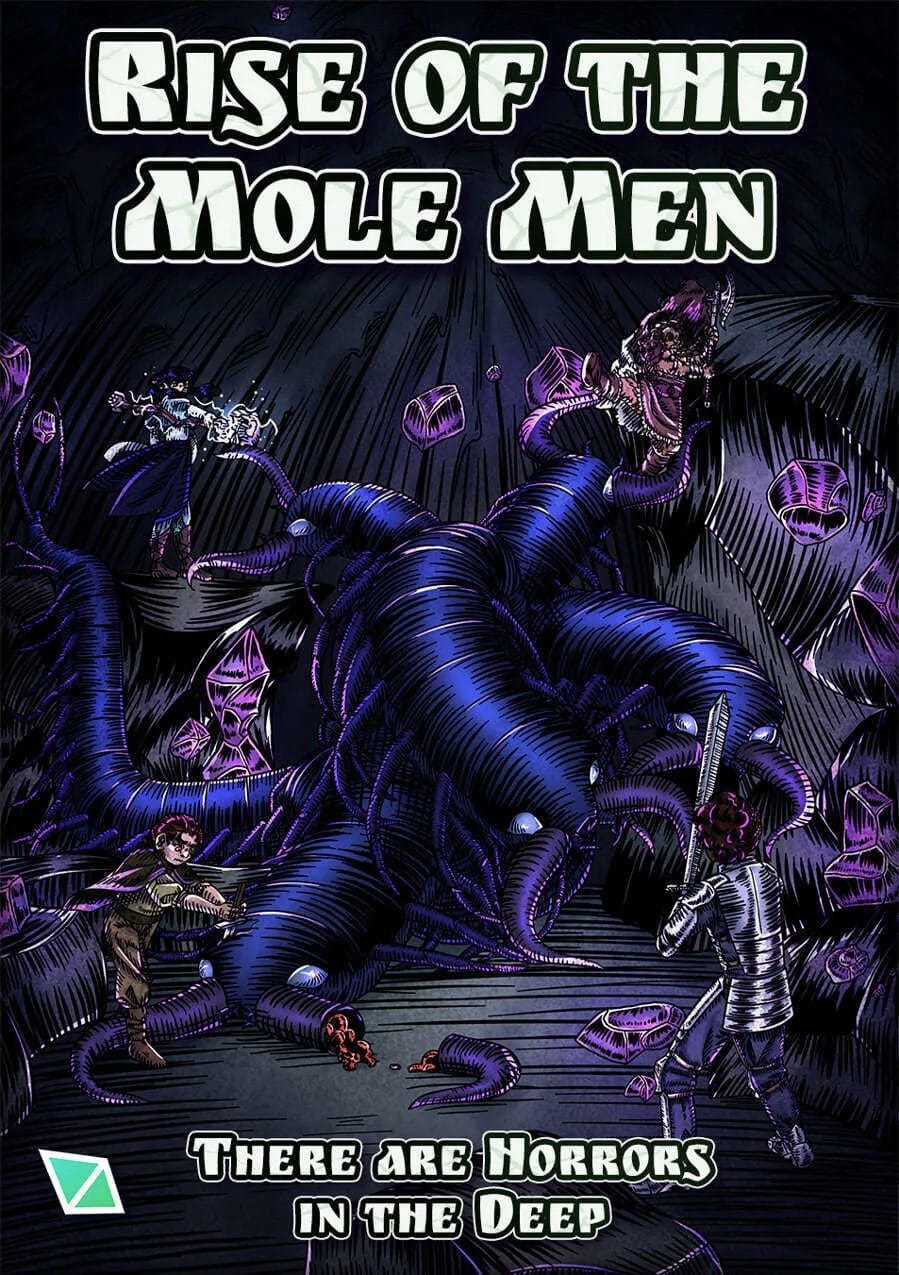
Those additional PDFs are, as far as I’m concerned, the only real barrier to entry between running my adventures in a more modern system. Any GM worth their salt can make some rulings in the moment on adding an appropriate skill check to a scene in an OSR adventure or what have you, but stats for monsters and items take considerable amounts of time to convert. Designing monsters for 5e takes a long time, and it’s difficult to do well. I have a lot of experience doing it, so I might as well do the work for some of my readers.
For example, for my home group a few years ago, I ran the D&D 3.5 adventure, Red Hand of Doom, in 5e. Fantastic adventure, I’d highly recommend it! But by far the most time-consuming aspect of preparing that adventure was converting the 30-odd unique stat blocks from that adventure for use against 5e characters. Preparing the rest of the adventure took a fraction of the time by comparison.
Otherwise, I try to keep my adventures as close to the OSR design basis as possible. I don’t want to compromise what the adventures are for the sake of what a smaller percentage of readers might like them to be. I’m more than happy to accommodate those readers with these extra resources, but personally I don’t think they should need anything more.
Your “Reimagined” series systematically overhauls specific creature types, such as BEAST, GOLEM, and ZOMBIE. What flaws in standard monster design are you trying to fix?
The Reimagined series exists primarily to address a specific series of weaknesses in D&D 5e monster design: Beasts are largely missing flavourful aspects of certain animals, Constructs (particularly the namesake Golems) are poorly balanced around certain immunities that throw their challenge rating out of whack, and Undead are generally just very samey in their design.
In my opinion, the best monsters have something that forces the players to interact with them or the rules of the game in a unique way. It doesn’t have to be something crazy, but anything that can get the players out of a mindset of “I walk up to the guy and hit him.” Not every monster needs this (your goblins can just be little dudes with swords), but it’s always nice to see and bestiaries in a lot of games struggle to include it.
In a substantial compilation like Arcana Esoterica, you feature hundreds of options for player characters. How do you ensure player choices remain meaningful?
The best spells and items are the ones that excite you: they fulfill a fantasy and fulfill it effectively. If a spell doesn’t fill a niche or do anything interesting, then it probably doesn’t need to exist. Conversely, if a spell does something interesting but doesn’t do it very well, then something needs to change until it does do that thing very well.
The official site notes that Dice Average RPG is run by you and lead artist Artificial Jealousy. How does that creative partnership function?
AJ and I have worked together for a long time now. For most projects, we’re leading with the book’s content and filling white-space with art as required, but for some recent projects, we have been concepting adventure locations before writing begins. AJ has been especially instrumental in us making the move to attend conventions. She led the charge in us going and found the vast majority of our equipment. I’m not even remotely wired for that kind of planning and I would never even have thought to have done it without her, let alone have succeeded.
Out of everything you have released under your banner so far, which specific book or project would you most like to be known for, and why?
It might be a bit of a cop-out, but our recent adventures are some of my favourite things I’ve ever worked on. If I had to pick one, I think right now it would be Where Fire Lives. It’s a frenetic dash of an adventure and running it is a delight.
Your professional profile mentions a new product scheduled to release in the very near future. What can you tell us about it?
Currently, we have a number of adventures in the pipeline, but right now, AJ is working on an adventure of her own that I’m about to do a first editing pass on. It’s called The Spire That Sinks, and it’s hopefully going to be available for the first time at Norwich Games Convention in August! It’s about an upside down wizard tower filled with decaying arcane contraptions and enchanted objects.
Beyond that immediate release, what else do you have in the pipeline for the rest of this year?
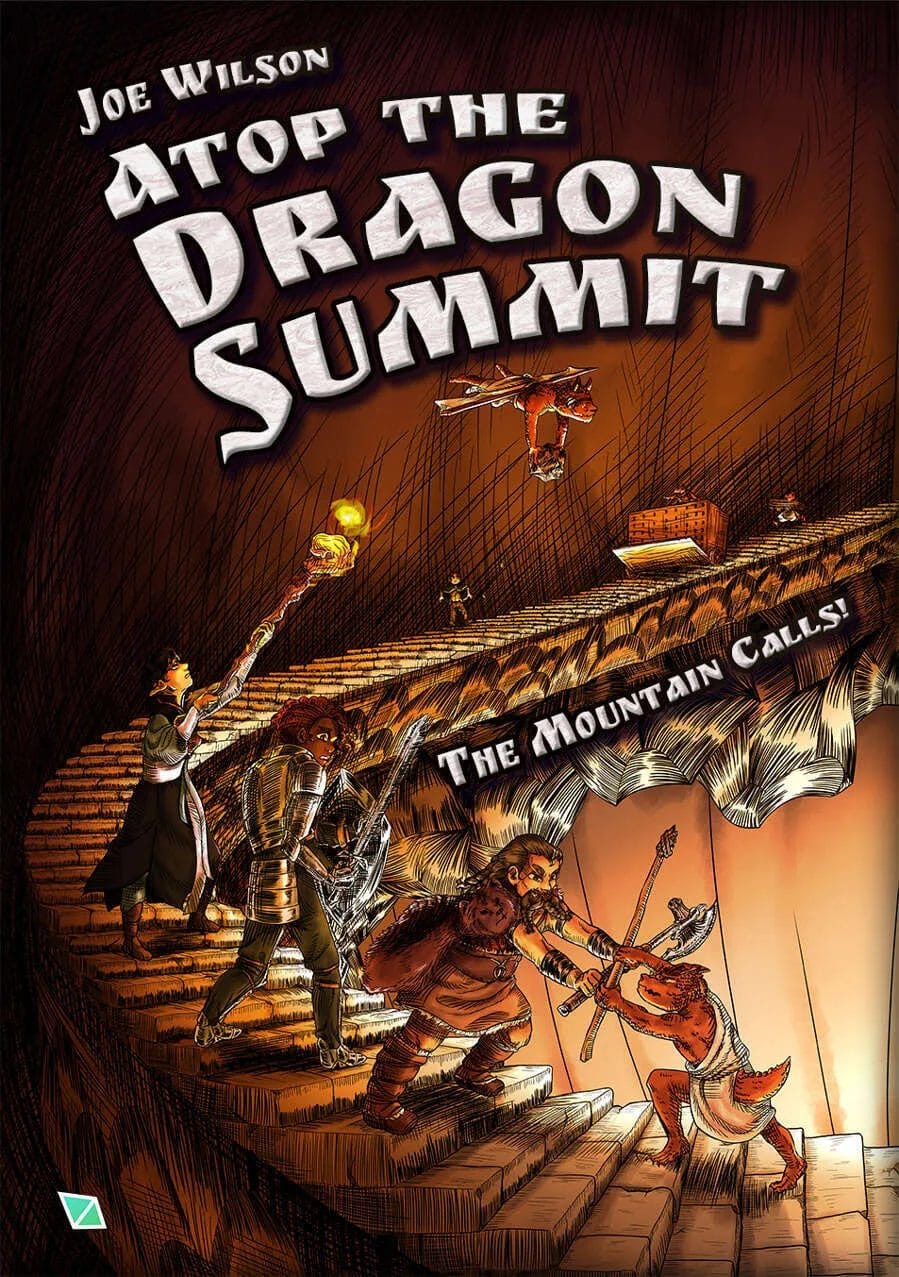
The rest of the year is pretty par the course of us: we have at least two other adventures hopefully releasing in October & December respectively. The first is Bargaining with the Beast, a horror adventure about the circus, and the second is a currently-unnamed hexcrawl adventure about hunting a wyvern. Early next year, I’m hoping to publish an adventure by Diarmait Finch, The Gorgon’s Geode.
Is there anyone else in the tabletop roleplaying community you would love to collaborate with on a game or a supplement in the future?
I’ve had the privilege of meeting a lot of great people in the industry this past year, but if I had to pick anyone, I’d love to work with Snow Battle on some kind of worldbuilding project. I’ve been following her work for 7 or 8 years and the worlds she builds are fascinating. I think about Endsville – a Primer to the Cage daily.
You can check out the library of system-neutral modules and character supplements directly on the Dice Average RPG digital storefront. Their upcoming adventure module, The Spire That Sinks, is scheduled to debut this August at the Norwich Games Convention, followed by the circus horror module Bargaining with the Beast in October.
Read more at this site