

Earlier this year, Kobold Press held a Q&A for the release of our Northlands Worldbook on the D&D Discord server. Here’s a lightly edited transcript!
Q from RisingDusk: If you had to pick only one monster from the Worldbook to sell DMs on buying the book, what monster would you pick and what makes it so special?
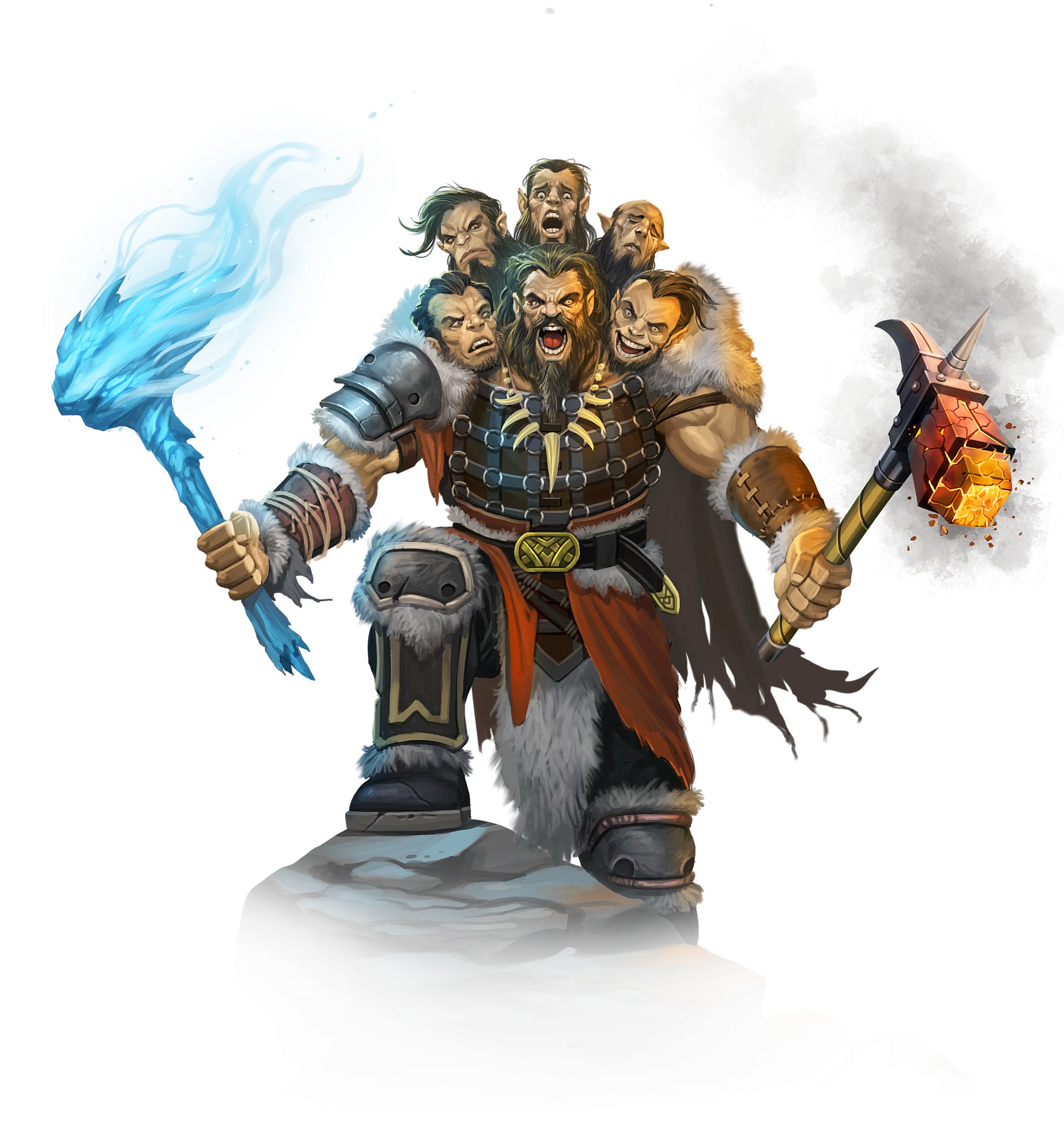
A: Dang, that’s hard . . . my favorite is probably the thrudgelmir giant. Who doesn’t want to have a six headed giant smashing up your PCs? It really embodies this epic, North vibe that we were striving to convey in the books. Also the roleplay potential alone is amazing, and possibly hilarious.
Q from 4k31gv: Will there be more books available on D&D Beyond in the future, such as Tome of Beasts 2 and Tome of Beasts 3?
A: We are hoping to have more on D&D Beyond! The more people clamor for them, the better the chances, I’d think.
Q from Zan: What is the difference between Northlands Worldbook and Northlands Sagas that makes them worth the same amount of money?
A: So the Northlands Worldbook is a campaign-overlay, which means it is something you can use on its own OR put into your own campaign, regardless of the setting. The Worldbook has lore, and regions, and player options (subclasses, species, spells, items, feats….etc.), as well as new monsters and new mechanics.
Northlands Sagas, on the other hand, is a full adventure path taking PCs from levels 1 to 13 and involves working with Loki to stop Ragnarok. They are both amazing (though I might be a bit biased), and are designed to work together to give you all of the North-themed adventuring you could want.
Q from SodaPopBarbecue: Did the Kickstarter not meet its stretch goals? There’s no Ratatosk species updates in here . . . I like those playable squirrel people so much!
A: Yeah, we didn’t quite reach the stretch goal for the Ratatosk and Ravenfolk. We had some cool stuff planned for those little squirrel guys. Maybe someday . . .
Q from SodaPopBarbecue: If you were given access to the Artificer kit, what kind of Artificer would you be interested in designing?
A: I think it might be interesting to see a biomechanical Artificer—someone “crafting” in flesh, able to physically boost or alter themselves or their companions.
Q from SodaPopBarbecue: Trickster Warlock, as written, allows for Minor Illusion to deal 4d10 Psychic damage and be stunned when a creature interacts with a sound. Is this not broken beyond reasonability for a Cantrip? (Likewise, Context Switch & Distant Switch can, as written, cause an opponent to attack themselves if they fail the save.)
A: On the Trickster Warlock question, by the time you hit 10th level a lot of cantrips are doing nearly this much damage on a successful hit. And this one only works if they fail the save (half if they succeed). So the math means it’s only slightly more powerful than, say, Firebolt.
Q from RisingDusk: What motivated creating Giantkin when Goliath are a PHB and SRD species now?
A: We had two reasons for creating the Giantkin:
1. Giantkin sounds more North-y to me than “Goliath” (not that I’m knocking Goliaths).
2. We also wanted to publish this for our own Tales of the Valiant system too, so we wouldn’t be allowed to use Goliaths for that. For the sake of design continuity we decided to create Giantkin.
Q from 4k31gv: For the spells, Glimpse the Wyrd and Pawn of the Wyrd in Northlands Worldbook, since the range is listed as “Self” but the spells modify another creature’s action, how far away can that creature be? Is the intent “any creature you can see,” or is a range missing from the spell text?
A: Man, you folks are making me flip through the books! Lol. So for Glimpse the Wyrd and Pawn of the Wyrd, as written, there is no range. I suspect that might get errata’d at some point. I would say that the range should be listed in the reaction requirements as “a creature within 60 feet.” I’m gonna throw this one to our errata file.
Q from ShankMugen: What is the reasoning behind using the “Wotan” spelling instead of the more common “Odin” for the pantheon?
A: We based Northlands vaguely on the Northlands of our own Midgard setting, but with the serial numbers scrubbed off and used as a campaign overlay. The original Northlands material from Kobold Press way way back used Wotan, so we continued to use it to maintain continuity of design. Technically, Odin is the Scandinavian name and Wotan is the Old High German name. Midgard was originally a grim-dark setting with heavy German influence so, there you go.
Q from LaTiaJacquise: can you clarify what you mean by “campaign overlay” as relates to worldbooks?
A: Sure thing! A campaign-overlay basically means that it is a product that is as rich and deep as possible in terms of setting, but it’s designed so GMs can drop it whole into whatever setting they are using, OR use it as its own setting. So if you were playing Eberron, for example, you could place the Northlands out in the ocean between Khorvaire and Everice/Wayfinder Tundra.
Q from Skye: What’s your favorite spell in the book, why, and what class/subclass would you build around it first?
A: Anytime someone asks me about my favorite things, my mind usually turns to the ones I find amusing or hit on a theme that I find interesting.
In the case of the Northlands, I like the spells that touch on the Norns. The idea of divination or fate in TTRPGs has always been interesting on a design level. How do you make rules for someone who can know the future, especially when there is really nothing predetermined at the game table? You can cast Augury and stuff, but it’s always non-combat related.
So spells like Bound Fortunes are cool to me because they provide “combat” ways to use fate and fortune. Beseech the Norns hits on that same theme. In terms of a subclass designed around that, I think a Fate-based warlock who did combat divination would be awesome!
Q from ShankMugen: I was wondering which subclass would fit best for an Einherjar character, both as NPC as well as a PC, according to you.
A: Ooooo, an Einherjar character would be pretty cool. So the Einherjar are spirts of warriors who were chosen by the Valkyries to go to Valhalla. The easy choice would be the Paladin Oath of Valhalla subclass. But I could also see an interesting combination with the Skald Bard or the Circle of Fenris Druid, although that last one might be a bit of an outcast.
Q from Halloween: How do you get into working for publishers like Kobold Press? What do you usually look for?
A: Well, my process was a bit uncommon. Back in the depths of time, I signed on to a LiveJournal (for those of you old enough to remember LJ) where Wolfgang Baur was hosting a patron-system where you paid him a small amount of money and you got to sort of look over his shoulder as he designed things.
That morphed into the Open Game days which later became Kobold Press. I freelanced with various TTRPG companies for about 35 years before getting a full time gig with Kobold Press. Though I always wanted to be a full-time designer for KP. Getting into the design business these days is a lot about making contacts, doing smaller jobs and open calls.
What I personally look for in a designer are a few key things:
● Know the material, and especially know the format of what you are being asked to write. This includes how the company’s products are written. You need to be able to follow that format because if you don’t, you are only making more work for the editing team.
● Be creative with an eye toward playability. Writing for your home group is much different than writing for publication. You need to think about how GMs and players will handle things if you aren’t there to explain it.
● Hit your deadlines and word count goals.
● Communicate, communicate, communicate. There is nothing a publisher hates more than when a designer goes silent. You may not want to contact whomever has given you a job to say you are going to miss a deadline, but they would MUCH rather hear that you’re going to be late than to hear nothing. Life happens and people are understanding if you give them the heads up.
Q from LostNord: Question: who would I have to bribe to get all the Tome of Beasts books updated to 5.5 and in dnd beyond? Or are there plans to do that?
A: Who to bribe? Hmmmm . . . I don’t know if D&D Beyond takes bribes but it couldn’t hurt? We’d love to update all of our monster books to 5.5. It’s a question of time and schedule mostly.
Q from JasonCitron: Are Giantkin and Goliaths the same species in D&D? If different publishers keep using different names for the same creatures? Does this redundancy create confusion for players over time?
A: That’s a tricky question. Are they the same? Not technically. We didn’t use Goliaths for the reasons I mentioned above, but they do fill the same niche.
If I was running a campaign that had both Giantkin and Goliath, I would probably treat them as the same species. Just off-shoots of each other.
It can be confusing as you mentioned but the realities of TTRPG publishing is that sometimes companies put out things that are the same. If I’m remembering correctly, Kobold Press came out with “dragonkin” before WotC came out with dragonborn. Over time, we changed the name over to dragonborn to match WotC and avoid confusion.
Q from RisingDusk: Have you given any thought to how the adventure path in the Sagas book might fit into the official D&D settings? For example, could you run it in Icewind Dale? Any suggestions or ideas for how to do that?
A: You could certainly run it in Icewind Dale. Or in the Everice region of Eberron. This question also applies to using the Worldbook in WotC settings.
The “easiest” way to do that is to place a narrow body of water between your established setting map and the Northlands and drop it in there. By making that separation, it enforces the idea that this is another country. I’d play up that they have different names for the gods (though many might be just the same deity with different names) and different cultures, etc.
For Sagas you’d have a choice. Either treat the regions covered by the Sagas adventures as a separate country as I mentioned above, or you could try to integrate it. Integrating Sagas would be a bit more complex. To do it, you would have to take the set locations of the adventures and find places to stick them in your setting. For example, the Fortress of Birgkrona in Adventure 9 of the path could be placed in the giant controlled regions of Icewind Dale.
You probably could also swap in the gods of whatever setting you are using (Forgotten Realms, Eberron, etc.) for the North-themed gods in Sagas. But if you did, you’d miss out on all the sweet sweet interactions with Loki.
Q from Jay: During Koboldcon, I believe I saw you playing Loki as the DM. What did you find fun about playing that NPC and do you have a memorable NPC you’ve played in an adventure?
A: I’m not going to say that Tom Hiddleston didn’t influence how I played Loki as a GM. Lol That said, I always love tricksters as NPCs. They can be allies, they can be foes, they can float between them over the course of a campaign.
I ran a weekly Eberron game for about seven years. During the campaign the PCs were guided by a seer who showed up from time to time. Originally, this NPC had a bit role, but the players found her very very annoying. Okay, well one specific player found her annoying. So I kept bringing her back. She’d show up and give some super vague prophesy (vague enough where almost anything could be said to fulfill it) and then wander away. The groans around the table when she appeared were totally worth it.
I also ran Wild Beyond the Witchlight for a game group of kids (my son’s friends). The kids group has been going strong ever since 2020. Anyway, when Will of the Feywild showed up, I gave him a slacker surfer accent. The kids loved him so much that he appeared almost continually though that campaign and the next.
Q from Halloween: What are the better places for getting into the design business aka where to make contacts, do smaller jobs and open-calls?
A: These days its hard to say. I think DMsGuild is a solid place to start because you are basically given all the pieces you need. Publishing some strong work there and accruing sales numbers can be something to show other companies.
As with almost any job, a lot of this is contacts. Go to conventions, talk to designers. Interact with them online. Some companies will put out open calls for pitches. Other times you can send inquiry letters to a company along with samples of your work to see if they would consider you.
I’m not gonna lie. It’s not easy, and its very very hard to make a living doing this. I’ve been doing this for a long time both as a freelancer and now as a full-time designer, and I don’t think my name is something that falls from the lips of TTRPG fans everywhere. But its what I love!
Q from Jay: With respect to Northlands, do you feel like the setting sometimes influences the amount of a certain pillar in adventures? As an example, with Northlands being very much akin to Vikings, does it lend itself more to combat than roleplaying?
A: I don’t think it does lean more toward combat than roleplaying exactly. A lot of that depends on your game group and GM. I mean, I could roleplay a phonebook. But I’m that kind of player.
That said, the themes of the Northlands (much like the Norse mythology its drawn from) does gravitate toward “earning” a place in Valhalla. By that metric, combat gets a bit more weight.
We stress in the book that earning a place in Valhalla isn’t limited to dying well in battle. That’s just the easiest way. Fame and renown can come from excelling as a bard or as a healer.
I’m known in certain circles as being a bit obsessed with mimics. I’m currently forbidden from making more mimics by my boss. You make one mimic moon and they get really twitchy. But I managed to get a mimic into the last adventure of Sagas, which made me happy.
Q from Jay: Speaking of mimics, can you weigh in on a philosophical question my table brought up? Is a mimic mimic just a normal object (i.e. a mimic mimic chair is just a chair) or is it something more sinister?
A: I created a stat block for a Faux-Mimic once. It’s just a wooden chest carved to look like a mimic. I’d say a Mimic-mimic might be like the old Gas Spores. Those floating gas fungus that look like Beholders? When you go to attack them they explode? So a Mimic-mimic could be a creature pretending to be a mimic who is pretending to be a chest. It’s like a turducken.
The thing about Mimics is that they are kind of ridiculous. They always were. I mean, just how often do adventurers go into dungeons that a creature could survive just sitting around as a chest waiting for someone to come along?
Now, a creature who can disguise itself as mundane objects in order to hunt—that’s a scary creature. When I design mimics, I always try to make them as active as possible, because otherwise your paranoid players are going to have their PCs just smash every piece of furniture they see.
The post Northlands Q&A with lead designer Brian Suskind – July 8, 2026 appeared first on Kobold Press.
Read more at this site