

By Jim Johnson, Project Manager
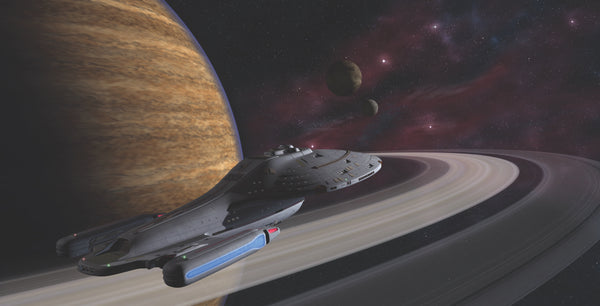
Art by Adam “Mojo” Lebowitz
As discussed in an earlier Star Trek Adventures blog article, first episodes of a new tabletop roleplaying campaign are like the first episodes of a televised series. The pilot, and first session, introduces the campaign and gives players or watchers a taste of what’s possible together.
Last week we looked at the Star Trek: Deep Space Nine pilot episode “Emissary.” This week, let’s analyze “Caretaker,” the pilot episode for Star Trek: Voyager, and examine the differences between the two pilots and how they might differently set up a TTRPG campaign.
Comparing Pilot Episodes – Emissary and Caretaker
Where “Emissary” teaches gamemasters how to build a campaign around a place adventure comes to, “Caretaker” suggests how to build a campaign around a journey, a divided crew, and a difficult choice that changes everything.
Remember that a great pilot episode introduces an enduring situation, creates tensions among the characters, and opens up multiple kinds of stories without resolving every underlying problem or taking agency away from the players.
“Caretaker” does all this effectively, setting up Star Trek: Voyager as a series with significant potential for storytelling.
If you haven’t seen “Caretaker,” or haven’t watched it in a while, grab some snacks and go watch it, then come back.
Key Campaign Elements in the Pilot Episode
After watching the episode, we can see that all the key elements needed to start a campaign are established:
- STARTING ERA OR YEAR: The opening exposition text and the opening scene show us this series is set in 2371, concurrent with the third season of Star Trek: Deep Space Nine. This gives us clear direction as to what level of technology we’re working with and helps the series feel familiar, even though the ship and crew are far removed from the Alpha and Beta Quadrants we’ve come to know from both The Next Generation and Deep Space Nine.
- MAIN PLAYER CHARACTERS: All of the main characters are introduced in the pilot, each getting one or more key moments. Janeway, Chakotay, Tuvok, Paris, Torres, Kim, Kes, Neelix, and the Doctor are all given focus as main characters.
- A DIVIDED CREW: The mixed Starfleet and Maquis crews present a fresh opportunity for potential conflict among the characters, something rarely seen on Star Trek or Star Trek: The Next Generation. Rather than presenting the characters as a unified team, the pilot and first season emphasize their different experiences, loyalties, and attitudes toward authority. The tension between Starfleet officers and Maquis personnel provides immediate opportunities for dramatic storytelling, an approach you could consider for your campaigns.
- SETTING: The two main settings of the series are introduced in this episode, the first being the U.S.S. Voyager, the only significant Federation presence in the Delta Quadrant for most of the run of the series. The second is the Delta Quadrant itself, as it is where the Voyager and her crew are transported to and spend the majority of the series working to escape.
- TONES AND THEMES: “Caretaker” lays the groundwork for a number of tones and themes that will develop over the course of the series, including the challenges of isolation, exploration of an entirely unknown region of space, divided loyalties aboard ship, resource scarcity when there’s no handy starbase nearby, and the sheer challenge of having to travel some 70,000 light-years to get home.
- SCOPE: Unlike Deep Space Nine, which begins with a Federation station positioned at the intersection of competing political interests, Voyager begins with a Starfleet crew stranded far beyond Federation space, forced to work with former enemies and make difficult decisions without the usual support of Starfleet Command. As the only Federation representatives in the quadrant, the crew feels the weight of responsibility and becomes aware that every choice they make may have powerful consequences throughout their region of space.

Embarking on new adventures while also working to get back home, art by Michael Toucher
Session One: Pilot Episode Components
“Caretaker” delivers on all of the key components useful to include in a pilot episode. Let’s cover them here.
- GREAT OPENING SCENE: Rather than opening with the Battle at Wolf 359, “Caretaker” begins with the Voyager pursuing a Maquis vessel in the Badlands. This immediately establishes a conflict between Starfleet and the Maquis, introduces the dangers of the region, and gives the audience a reason to care about the characters before the episode’s main crisis begins.
- SOURCES OF CONFLICT: “Caretaker” introduces several sources of conflict rather than relying on a single villain. The Kazon are a collection of rival factions whose competition for resources and technology makes them dangerous opponents. They demonstrate that the crew cannot assume unfamiliar civilizations will share Federation values or interests. The Caretaker is a powerful alien entity whose actions create the crisis and raise questions about responsibility, interference, and the consequences of good intentions.
- SENSE OF WONDER: The displacement of Voyager is the pilot’s defining science fiction moment. A technology capable of transporting a starship across 70,000 light-years introduces a mystery that challenges the crew’s understanding of space, energy, and alien capabilities. The Caretaker’s array and the Ocampa’s underground settlement provide further opportunities for investigation and reflection. The crew must understand the technology that brought them there while deciding how to respond to the civilization affected by it.
- CHARACTER SPOTLIGHT MOMENTS: Every main character introduces their capabilities in this episode, helping to establish the role each of them will play in the series. For example, Janeway must make command decisions under extreme pressure and balance her responsibility to her crew with her obligations to others. Chakotay represents the Maquis perspective and the possibility of cooperation between former enemies. Kes and Neelix offer connections to the Delta Quadrant and its inhabitants, helping the crew understand a region that Starfleet knows little about.
- A SATISFYING CONCLUSION: The ending of “Caretaker” provides an especially strong model for a campaign launch. Janeway destroys the Caretaker’s array to prevent the Kazon from exploiting it, despite the fact that the array might have offered Voyager a way home. She chooses to protect the Ocampa, leaving her crew stranded in the Delta Quadrant. This decision resolves the immediate crisis while creating the campaign’s defining predicament. The crew has a clear purpose, but no simple solution. The consequences of her decision shape every adventure that follows.
How to Create TTRPG Adventures from Pilot Episodes
Creating a campaign inspired by Voyager’s circumstances makes it easy to create adventures that involve the entire crew, provided the gamemaster deliberately varies the challenges from episode to episode. Following are some ideas on how to engage characters in a variety of roles:
- Command and security characters could negotiate with hostile factions, protect vulnerable populations, or make difficult tactical decisions.
- Science characters may be required to investigate unfamiliar phenomena, study alien life, or identify the properties of unusual technology.
- Engineering and operations characters may be tasked with repairing damaged systems, adapting equipment to unfamiliar conditions, and managing limited resources.
- Medical characters have opportunities to treat unfamiliar illnesses, address novel medical emergencies, and confront ethical questions about experimental treatments that may be beyond their understanding or that clash with their ethics.
- Counselors and diplomats may find themselves resolving tensions between crew members, building relationships with newly discovered civilizations, and managing cultural misunderstandings.
Consider creating opportunities that encourage players to use their characters’ values, department ratings, talents, focuses, and pastimes in new and creative ways. Remember that the goal is not to give every character an identical amount of “screen time.” Instead, make sure each player has opportunities to influence the ongoing story and that the campaign does not consistently reward only one style of problem-solving.

An opportunity to explore a strange new world, art by Kyle Toucher
Conclusion
“Caretaker” demonstrates that a great pilot episode can establish a campaign through a player’s single, defining decision. By stranding Voyager in the Delta Quadrant, the episode gives its characters an objective (get home) while creating opportunities for exploration, diplomacy, scientific discovery, personal conflict, and moral dilemmas. It also leaves viewers with questions that cannot be answered by a single adventure.
When planning your own Star Trek Adventures campaign, think about what your characters might face, what they may have to sacrifice, and what might keep them working together when the mission becomes more difficult than they expected. You do not need to strand a starship 70,000 light-years from home to establish an enduring campaign. You simply need a compelling situation, characters with reasons to care, and a universe full of possibilities.
Just remember to discuss the direction of your campaign with your group at Session 0, as some players might not appreciate conceptualizing a Starfleet campaign that suddenly turns into something completely different by the end of the pilot episode!
Hailing Frequencies Open
What do you think “Caretaker” does especially well as a pilot episode? Which of its techniques would you borrow when launching your own Star Trek Adventures campaign? Share your thoughts, favorite moments, and campaign ideas with your fellow fans at the official Modiphius Discord.
In upcoming articles, I’ll explore other Star Trek television pilots and examine what they can teach us about creating memorable openings for our own campaigns.
Thanks for reading this article, and thank you for your interest and support of Star Trek Adventures! Keep frequencies open for news about other upcoming Star Trek Adventures product releases. Live long and prosper!
TM & © 2026 CBS Studios Inc. © 2026 Paramount Pictures Corp. STAR TREK and related marks and logos are trademarks of CBS Studios Inc. All Rights Reserved.

Read more at this site