

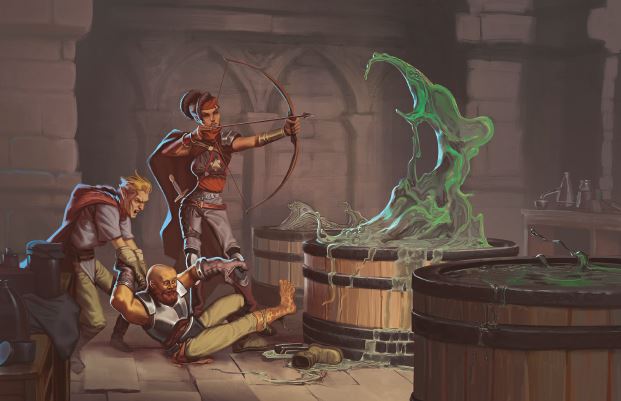
There’s a good chance that when your gaming group shares stories about their favorite gaming moments, nobody ever says, “Hey, remember that time we stumbled across that orc encampment, and there were precisely the right number of them to fight, so that we felt a little threatened but not really too much?” “Oh yeah, I drank a minor healing potion! EPIC!”
Balance is good. And that means it’s the enemy of perfect. Let it go.
When you skip steps on the encounter budget staircase, a great way to counterbalance your rule of cool is using the environs that characters will playing. After all, why should it only be epic monsters that get lair actions?
I’ve found that one of the best ways to offset players being outmatched is to give them tools in the world around them that allow a turning of the tide, changing “unbeatable” encounters into manageable ones. Players get to walk away feeling clever and awesome, and the GM doesn’t have to spend ages tweaking encounters or fudging dice rolls to get through it.
Tools of the Trade
Sometimes the best tools you can give players are inadvertent ones—or only semi-planned ones where you leave the ingredients for fun lying around leading up to a big encounter.
For example, maybe strewn throughout the areas leading up to your imbalanced encounter there happen to be some empty bottles or jars, and in another area, a leather tanning station happens to have some volatile chemicals lying about. All the players need to do is rip up some cloth and they’ve got firebombs!
Inadvertent tools don’t always have to be so synergistic either. Locales can contain seemingly mundane items: in my last adventure set in a swamp, there were abandoned rowboats, block and tackle, rusty spears, and bags of crocodile bones. They might prove useful one way or another, but they don’t have to.
Players later used those rusty spears to bar a door shut along with wood from the boats while they immolated a den full of undead inside with the tanning chemicals. Shame the crocodile bones didn’t get used!
These are fun because it can be a surprise to both the players and the GM. However, these kinds of things don’t always make magic happen unless you beat the players over the head with hints. do enjoy metagaming, but leaning on an aspect like this too hard in order for characters to succeed is something perhaps too risky to be reliable.
Check Off Action Items
The better way to do this is to pepper your environments with actionable items. It’s not work-related! Actionable items are things like steps that crumble when walked on, ballistae, moving platforms, chandeliers to swing from, runic circles of power to stand in, and the list goes on forever. (There’s a whole section of these in Book of Blades.) I like to put these things in a few categories: boons, hazards, obstacles, and traps. There are also a few others I like to use, banes and gambits, but we’ll save those for the article on risk vs. reward.
For now, let’s break down these actionable items. What are they, and how do characters actually use them?
Boons/Blessings. These are purely beneficial elements that largely benefit the PCs, such as a weapon their oafish enemies couldn’t fathom operating, an ancient barrier that prevents magic from passing through it in one direction, hallowed ground where spirits of past fallen adventurers whisper advice into their ears, a cracked yet workable orb that casts magic missiles (unlikely to be taken advantage of by a horde of zombies), and so on. The method of interacting with these is simply for characters to use them.
Hazards. Hazards are environmental effects such as poisonous gas emanating from a cluster of mushrooms, bedazzling bioluminescent lights from creatures clung to a darkened ceiling, pits, pools, perforations, and other more conventional hazardous terrain. The methods of interacting with these things are typically avoidance, mitigation, or nullification. With the right moves of course, foes can be forced into these hazards while the characters play it safe! (These are a feature of the Tales of the Valiant RPG, by the way. Check them out in detail in the Game Master’s Guide.)
Obstacles. Different from hazards, obstacles are large environmental objects that can hinder or alter characters movements depending on who’s navigating them. Things like climbable scaffolding for a height advantage or for accessing an exit or boon, a mass of brambles for smaller characters to hide in and attack from, a chasm bridged by a fallen (potentially crumbling) pillar, or a deactivated golem that might animate if the right words are spoken. The method of interacting with obstacles is usually traversal, avoidance, or destruction.
Traps. It may seem odd to differentiate traps from hazards and obstacles, but traps are truly their own beast. While fifth edition hasn’t given them the focus they deserve [ed. note: ToV fixes this! Check the Player’s Guide or GMG!], it doesn’t mean you shouldn’t use them liberally. They can be anything from complex pendulum blades to rolling marble statues to a convoluted series of buttons and levers that force parts of the environment to move, disappear, or otherwise vastly change how combat flows or how characters make decisions. The main ways to interact with these are avoidance, neutralization, triggering, or destruction. Also, traps don’t always need to be aimed at the players; some of the best traps are the ones the kobolds set for the adventurers only to have triggered on themselves.
Generate Some Reports
Making things interesting for your players can be as easy as having the encounter happen near an abandoned bolt thrower, or as convoluted as involving several moving platforms, each of which possesses a sigil that grants a different boon that aids in defeating their enemies.
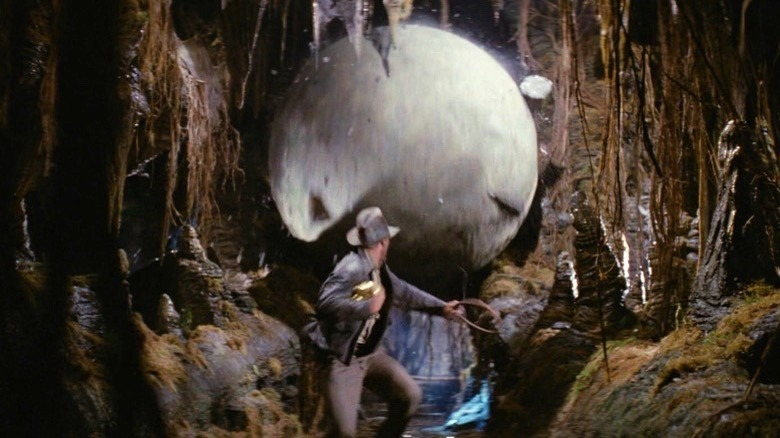
Take inspiration from your favorite films, books, and movies. It’s worth noting that most of those stories from your favorite media aren’t designed to be “balanced encounters,” and the situations contain absolutely bonkers odds. You should give your players some of those feels when you can. Sure, it can incorporate more moving parts than your standard initiative count of players and monsters, but it’s rewarding when your players still talk about that absurd encounter with the beholders and the mirror pillars that caused its eye beams to bounce around the room like an ‘80s night club.
When you give players the tools to be creative or turn the tide of a battle, unique things pop up. I’ve seen sarcophagi lids used to build makeshift barricades, surf boards, and even a bridge. Turns out sarcophagus lids are basically the Flex Tape of RPGs. I once had a party stuck in a pit use adhesive to stick gold coins together to make handholds which they then glued to the walls to climb to escape because they were out of spells and had lost their grappling hook. Afterward. they were poor but alive!
Let’s Circle Back Next Week
Anyway, think of all of these action items like little toys, little badges you can pin to your encounters. How many pieces of dungeon flair are you using tonight? Next time we’ll be talking about risks and rewards worth (maybe) dying for.
Read more at this site