

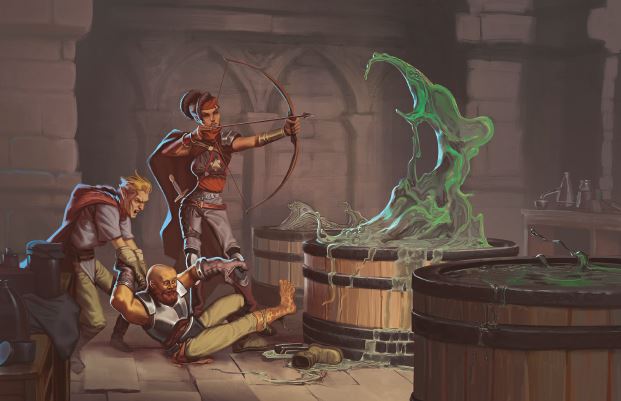
When your gaming group shares stories about their favorite gaming moments, nobody ever says, “Hey, remember that time we stumbled across that orc encampment, and there were precisely the right number of them to fight, so that we felt a little threatened but not really too much?” “Oh yeah, I drank a minor healing potion! EPIC!”
Balance is good. And that means it’s the enemy of perfect. Let it go.
Read all The 4th Pillar articles!
Having Cake and Eating It
It’s possible to play by the encounter design rules but still use the tools we’ve outlined so far in this series without totally breaking everything. This might apply to anyone who’s still new or unfamiliar with GMing or who perhaps hasn’t found their style yet. Despite everything I’ve said, it’s totally okay to do it all by the book, especially when you’re still getting comfortable. This series is aimed at more seasoned GMs, but you can still put to use everything from the boons/blessings, hazards, obstacles, and traps sections.
You can also use gambits and oddity XP if you’d just like to tack on some stuff for spicing up the way your game plays. You can add in unexpected stuff to make combat memorable and still stick to the budget. Just make a monster seem out of place. Give it an odd personality or some memorable quality beyond its normal means. You can do all of this and still stick to the XP budget as long as you remember one thing, the 4th pillar: fun.
As long as your players are having fun in your world, that’s all that matters. I know this seems like a cheesy “it was about the friends we made along the way” tripe, but it’s true. A lot of time is spent making our games the “best” or the “deepest” or the “most immersive,” but the reality of it all is that most folks just want a release from the doldrums of their everyday lives.
RPGs as a Medium
Roleplaying games provide a unique opportunity for this, unlike any other medium. RPGs are a medium unto themselves, different from movies, books, shows, or other forms of games. You could say that RPGs are “storytelling,” but they’re more than that. The sum of its parts doesn’t come anywhere near its whole.
Because of this, you can take all of the advice so far in this column about tossing the rules out the window and toss that out the window. You can stick to all the rules as written if you’d like. I’d respect that as long as it was in the name of fun.
The thing about fun is, no two people have the same definition. You can get a close match, but I’d argue that what people find fun is a bit like a fingerprint. This series was written to help you find some of those elements if you were struggling with some of the more “restrictive” tones and guidelines found in your rulebooks.
Planning for the Unexpected
Regardless of your play style preferences or rules system, any good campaign starts the same way as a book report: with an outline. Having a basis to run your sessions from will give you a huge leg up. You don’t need to know all the details, simply some high points and events and locales you want to cover in a chronological list, each with a few bulleted items beneath them. Starting with these simple concepts allows you to plan ahead for when you want to challenge your players the most and set up these set piece battles and unexpected encounters we’ve talked about.
I’m not suggesting you map out decades of world history or plan encounters for every session in your campaign. That’s counterproductive. Set aside time to block out five sessions, within each session plan three scenes or so. Within each scene, list about five bulleted items that are callouts to the big parts of that scene. It could be a battle or a memorable NPC interaction or a massive statue that dominates an area and provides intrigue.
By doing this, you’re planting some seeds in your brain and letting them germinate as you look over your session outlines. This gives you a cohesive idea of where you want to go and where you’ll take your players along the way.
Plans Schmans!
You may be saying to yourself, “But I want my game to be a sandbox! No rules for me, guy!” And to that, I reply with the same advice. Having sessions and chunks of ideas ready for your game not only helps you as a GM, but you’ll be helping your players have fun by having things ready to pull out. They don’t have to match up or come in the order you planned them, but you can always reskin one on the fly.
Maybe your plan for the gigantic, moss-covered, carved head of a lion god in the middle of a hidden ruin gets tossed out the window because your players want to go shopping. Instead, take that and put the basic idea in the middle of the marketplace. An odd obelisk shows up or a rare, green lion is transported through the market stalls. Either one of those things can point your characters in the direction you want to take them with perseverance.
Even the biggest, most sandboxy open worlds have scripted events and templated encounters ready for you at all times. It’s all about player perspective, and having these things ready ahead of time will only help you sell it more!
Up Next
Speaking of selling it, next time we dive back into the whole “ignore the rules” talk while I walk you through how to outline a campaign using principles we’ve discussed here. Until then, game excellently with one another!
Read more at this site