

Over the decades, Kobold Press has published game material and adventures for systems from Call of Cthulhu to four editions of Dungeons & Dragons, and from Pathfinder 1E to Tales of the Valiant and RiverBank RPG—and about five more game systems in there as well.
Kobold Press CEO and Kobold-in-Chief, Wolfgang Baur, is here to give you some insight on the state of the industry!
Generally, publishers focus on just one system at a time. The exceptions can be instructive: writing the same adventure with two different sets of stats sounds like a great way to expand the potential reach or audience. And it can be! But often, it’s twice as much work for about 50% more pay, so . . . it’s a rarity.
Let’s take a look through multi-system publishing over time, starting with what might be the greatest multi-system RPG product ever created.
Thieves’ World by Chaosium
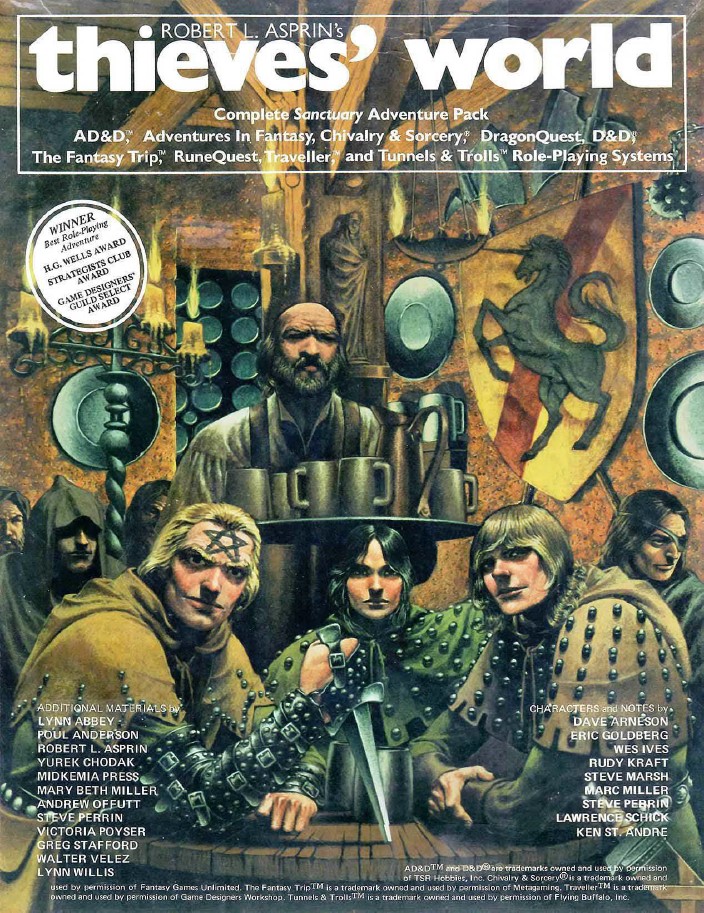
My first encounter with multi-system publishing was the Thieves’ World boxed set, which included eight (8!) sets of stats for that iconic low-fantasy setting. The lead system was RuneQuest, of course, but they also covered Tunnels & Trolls, Advanced Dungeons & Dragons, Adventures in Fantasy, Chivalry & Sorcery, DragonQuest, The Fantasy Trip, and Traveller.
It was 1981 and things were WILD.
The product itself was six items in a boxed set (Player’s Guide, GM’s Guide, NPC Book, and 3 maps). The clear intent was to make the setting playable for anyone coming to it from RuneQuest or AD&D or smaller systems. The power of the box was in the joy of the world and its characters, who were all shared-world fantasy heroes in the Thieves’ World collections of fantasy fiction. Surely, it should have sold eight times as many copies as a TTRPG release for just one system, yes?
Frankly, it’s still bizarre that this ever happened. I can’t imagine a project like that happening today. Getting agreement not to sue from eight publishers feels like a huge lift. Chaosium just did it!
I cherish this boxed set to this day, because dang. Publisher goals.
Kobold Multi-System History
Kobold Press has, of course, done multi-system projects, including company highlights such as Halls of the Mountain King for Pathfinder 1E and 4th Edition D&D (2015), the Midgard Worldbook for Pathfinder 1E and D&D 5E (2018), and the triple crown: The Old Margreve for Pathfinder RPG, 5E D&D, and Tales of the Valiant RPG.
Most of those multi-system projects were done during times of fragmentation in the TTRPG hobby and in times of transition. When the fantasy RPG audience moved from one generation or edition to another, Kobold Press followed, but often with a period of supporting older systems or branching out to do a 13th Age or AGE System product (by AGE line developer Jeff Tidball, no less!).
So while Kobold has supported multiple systems over multiple years, let’s go with one of the biggest. The 8-year run of Kobold Press publishing for Pathfinder RPG started with Secrets of the Alchemist in 2010, and it did not end until the Midgard Worldbook in 2018, long after 5E took the crown for biggest fantasy RPG. However, the majority of the 142 Pathfinder RPG titles that Kobold Press created were for single-system players and GMs.
That supports the reality that multisystem publishing isn’t viable for most publishers, most of the time. The Thieves’ World project is a HUGE outlier, and please note that even now, Paizo does not publish dual-system products for Pathfinder 1E and 2E.
The only publisher I know who does multi-system work consistently is Legendary Games and their Tales of the Valiant support is stellar. But this level of multi-system support is incredibly rare. Maybe some OSR folks support two or three related rules sets, I don’t know.
Why Not Keep Going?
Why NOT do the Thieves’ World approach of rules for every system that is even remotely popular? I mean, no one’s advocating a return to Chivalry & Sorcery RPG support, but surely a high-fantasy game book that covers D&D, ToV, Pathfinder 2E, OSE, 13th Age, Shadowdark, Cypher System, and Daggerheart would attract customers from all those disparate fan bases.
Think of the composite power of catering to every denomination of the Tabletop Tent! To be nakedly commercial, think of the money a publisher could save on art costs! It’s a cash bonanza for anyone brave enough to try it! It just makes SENSE, right?
Well, no. It doesn’t.
Why Multi-System Books Fail
There are two reasons why most publisher stick with one system per book: game community tribalism and unit costs.
I’ll talk about them both in the context of how they work in a single game book.
Two Systems in One Volume: Jealousy
As a designer, it can be fascinating to see the same adventure or the same worldbuilding or character options expressed in multiple ways and for different systems. The Thieves’ World box made it clear to me that some games are compact, highly-structured, and have clear rule sets, while others kind of . . . rambled with obscure abilities and heavy jargon.
They were all talking about the characters I loved from the novels, and it got me interested in expanding my gaming horizons. The reality, though, is that my players only cared about Traveller and D&D at the time, so those were the rules I valued. And nothing has changed about system preferences like that.
If Kobold Press published something for four popular systems tomorrow—say Daggerheart, D&D, Pathfinder, and TOV, some people would be delighted to get that additional play material.
However, MOST of the audience would be jealous and annoyed, in a tribal way, that Kobold Press was “betraying” their preferred game by giving time and attention to other rules system. Those Daggerheart pages or Pathfinder pages would be denounced as “wasted space” and “useless” by people playing TOV or D&D.
Ask Me How I Know
How do I know? Because every single multi-system project I’ve been part of has had that reaction from a large portion of the fan base. Rather than celebrating the breadth and scope of the hobby, the most common reaction is negative whenever a game book addresses more than one system.
Why are humans like this? That’s a bigger question, but just like sports teams or nation-states, people are devoted to their side, their team, their flag, and their RPG. And that makes it harder to offer a single book with multiple systems.
OK, so . . . why not segregate by rules systems, then? Every tribe gets what it wants! It’s so logical!
Separate Books for Separate Tribes: Death by Unit Costs
The only thing worse than publishing a second, third, or fourth rule set in one book is publishing them in separate books, one volume for each rules system.
Consider for a moment a Temple of the Frog adventure designed for four editions, Legendary Games style. Written by separate teams, edited separately, laid out, and published to the standard of each rules set, and then published at the same time and sold to four different audiences.
This means the same art in each book, but the print run for each one is smaller. A lot smaller, in some cases. And as I discussed in a previous State of Play, In It to Print It, smaller print runs mean higher costs per book.
You can see how and why it raises costs in depth at that link, but here’s the TL;DR: Printing 2,000 copies of one book might cost something like $5 per book. Printing 1,000 copies each of two different books might cost $7 per book. If you were hoping to sell those books at $30 each, the first one has costs equal to 16% of the cover price, and the other two have manufacturing costs of 28% of the cover price.
Printing the same number of books in two similar-but-different volumes immediately costs you 12% of your potential profit. In a low-margin business, that’s sometimes the difference between making money and losing money.
Now consider that you have to market to four different audiences, and provide customer support for four different Discord servers or online communities, and provide errata four times, and maybe offer it to hobby stores with the same art but four different contents. It’s not just the game design team that will curse your name.
Two Exceptions to the Rule
I’ve made a broad argument here about rules and game books, but there are exceptions where clever design can make a huge difference: one is in adventures, and one is in game forks or closely-aligned rules sets.
Why do those work better than core rules, player options, or broad sourcebooks? For adventures, the answer is pretty easy. Adventures require standard monsters and a good combat options, but the area descriptions and plot remain the same. For an experienced player, it’s not difficult to use a Monster Vault orc, a Monster Manual orc, or a Pathfinder Bestiary orc, and for the designer, it’s often as simple as saying “five orcs”, with the reasonable assumption that people can look it up in their monster book of choice.
That still leaves double or triple stat blocks for Big Bads, unique NPCs, and newly created monsters. Those are often a relative handful; a boss, a lieutenant, a variant monster or original one, and a special NPC still adds up to just four stat blocks that require full design and space.
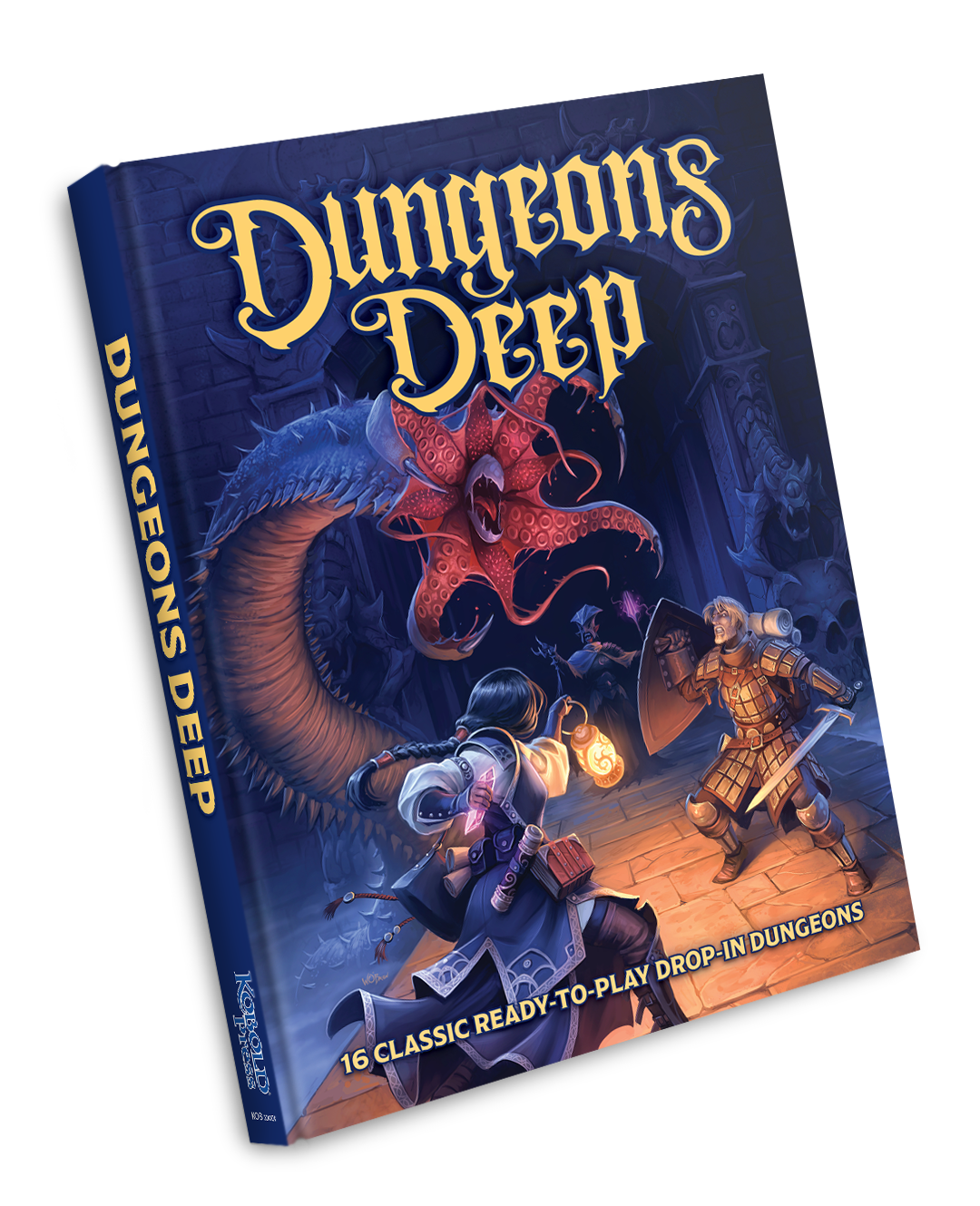
In a 32- or 64-page adventure, it’s not a burden to offer both, and it can successfully appeal to a broader crowd than a single-ruleset adventure. Naturally, it limits design to using primarily monsters found in both rules sets, but that’s not a deal killer. We did this recently with Dungeons Deep. Every adventure in this 176-page collection uses monsters that can be found in both the Monster Vault and Monster Manual.
Those rulesets aren’t terribly different though, which brings us to aligned rules sets. For Tales of the Valiant and D&D 5E, or for other closely-related rules sets like D&D 3.5 and PF 1E, you can literally provide one set of stats that are comprehensible to both audiences, because the differences are slight (hardcore nitpickers will find the differences, but they’re not likely to spoil anyone’s understanding of the encounter).
The same thing is ALSO TRUE for player option books in some cases. A Pathfinder 1E subclass or prestige class works fine with a D&D 3.5 game. A Tales of the Valiant subclass or background works with minimal fuss for a D&D 5E game—in the case of the Shard Tabletop VTT, you can literally run ToV and 5E player characters in the same game without any special mods. They are tightly aligned rule sets precisely because one goal was to make it easy to provide 5E D&D players with new material for their preferred edition (just as Pathfinder 1E provided new material for players who wanted to keep running D&D 3.5).
It can be done. But it’s hard.
Conclusions
People love the games they love, and they want you to love their game more than any other game ever. Trying to share two flavors in one delicious package doesn’t please everyone. However, sometimes you can offer chocolate and peanut butter—or Tales of the Valiant and 5E D&D—together and have something great.
But ain’t nobody gonna be publishing any eight-system boxed sets, anytime soon.
Read more at this site