

Trebuchet Games released Meaningful Connections: Running Better Roleplay Encounters to address one of the most persistent hurdles in tabletop roleplaying games: running non-player characters who actually matter. Written by Sarah Thomas, the 105-page supplement replaces improvised guesswork with concrete system frameworks and structured scene tools.
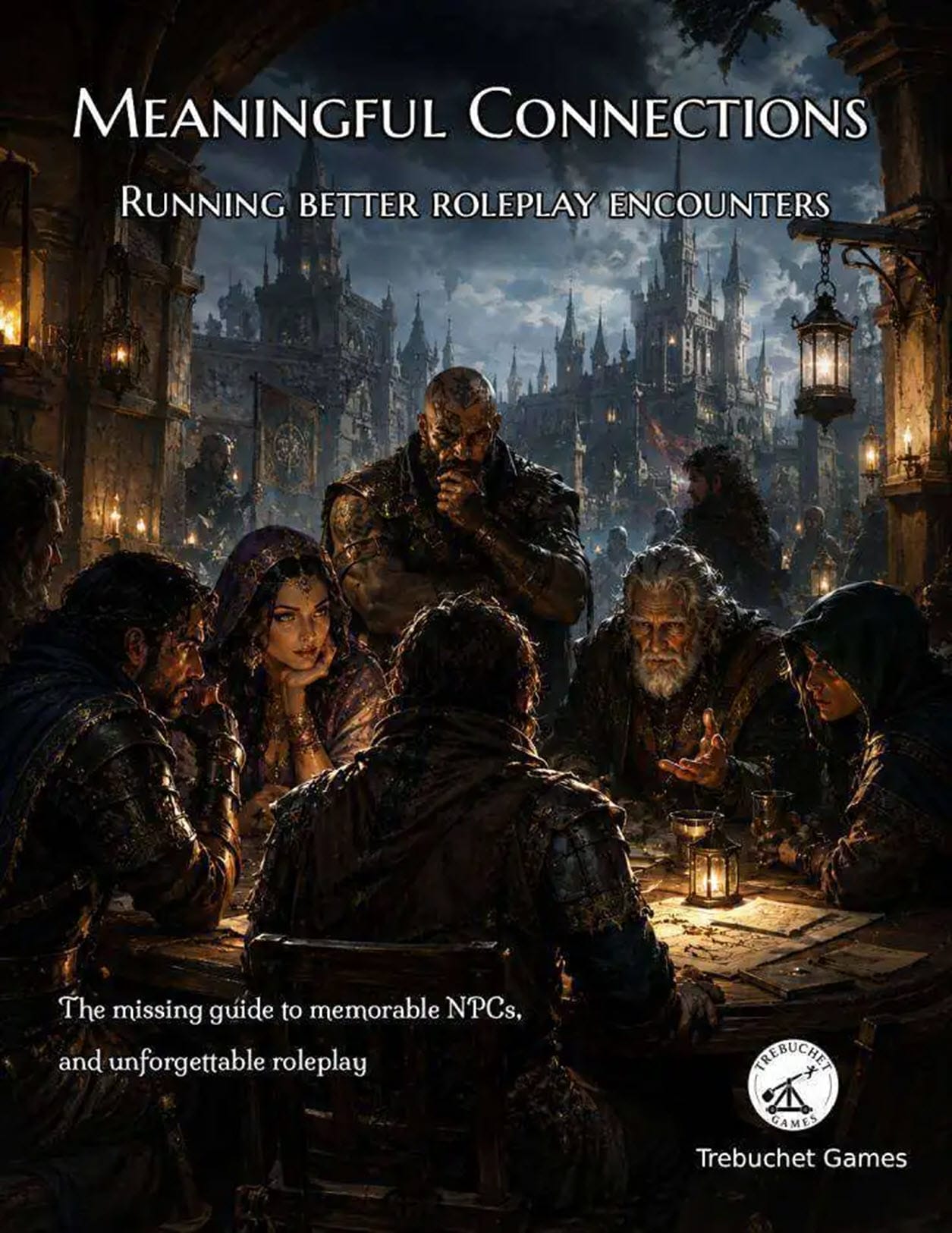
Many guides on non-player characters fall flat because experienced game masters already know basic roleplay advice. Trebuchet Games succeeds where others stall by offering actionable, modular depth that seasoned tabletop runners can sink their teeth into. The core engine relies on Trust Scores, relationship tracking, and lasting social consequences, turning bit-part actors into permanent fixtures of a living campaign rather than disposable plot dispensers.
System
The book runs on the fifth edition (5e) ruleset, drawing directly from the System Reference Document 5.1 under the Creative Commons Attribution 4.0 International Licence. While the psychological principles fit almost any tabletop setting, the mechanics rely on standard 5e statistics and D&D alignments.
The text provides explicit fifth edition hooks:
- Target difficulty classes for standard checks such as Wisdom (Insight), Dexterity (Sleight of Hand), and Charisma (Performance).
- Ready-to-run stat blocks featuring familiar combat abilities such as Action Surge, Second Wind, and Trip Attack.
- Broad, system-neutral categories such as Thievery, Lore, and Leadership to help game masters transport these social tools into other roleplaying games.
Non-Player Characters
Because this supplement focuses entirely on social encounters rather than bestiary combat, the book replaces monsters with a massive cast of fully realised characters. Sarah Thomas organises every personality into three practical tiers of preparation:
- One-Off NPCs: Background extras who need only a physical description, one distinguishing trait, and an immediate goal.
- Occasional NPCs: Familiar recurring faces who carry distinct mannerisms, secrets, and two to three memorable hooks.
- Major NPCs: Core campaign personalities built with long-term ambitions, complex backstories, and formal relationship webs.
The extensive Royal Ball encounter showcases this hierarchy in action. It details dozens of courtly figures representing rival nations like Eldoria, Frostwind, Stoneguard, and Stormwatch. Every persona includes concrete roleplay notes, starting stances, suggested dialogue lines, and hidden motives.
Game Master Section
The GM chapter forms the book’s mechanical backbone, introducing a numerical ladder for social standing. Trust Scores operate on a scale from -10 to +10, shifting only when meaningful events occur rather than through trivial bar banter.
| Factor | Description | Score Range |
| Event Severity | The tangible effect of an action, from minor assistance to violent harm | -6 to +6 |
| Innate Forgiveness | The baseline willingness of an individual to forgive, tied to moral alignment | -2 to +2 |
| Context Modifier | The underlying justification, covering self-defence, honest error, or malice | -2 to +2 |
Crossing specific mathematical thresholds triggers automatic behaviours without requiring a single dice roll. A score of +7 prompts an individual to assist freely at low personal risk, while a score of -10 leads to open hostility or direct violence at the first plausible opening.
Sarah Thomas also introduces tactical Social Battle Maps and time-phased Acts. These track movement and seating arrangements throughout large social functions. Plotting an NPC tracking system into an active dinner seating chart is arguably more administrative effort than I would bother with at my own table, but the sheer level of design detail is commendable.
Art Style
The book includes visual character portraits, scene layouts, and tactical floorplans created in Inkarnate. The illustrations rely on AI-assisted tools. This supplement would have been far better served by using Creative Commons or public-licence art rather than AI generation. Synthetic imagery has become an immediate red flag for the exact community of thoughtful hobbyists most likely to appreciate this book. Today people judge a book by the cover.
Beyond the illustration choices, the printable relationship trackers, scene checklists, and mystery worksheets in the appendices are clean, legible, and immediately useful for table preparation.
On the practical side, the printable relationship trackers, scene checklists, and mystery worksheets in the appendices are clean, legible, and immediately useful for table preparation.
Overall
Meaningful Connections delivers a thoughtful set of tools for tables wanting their social encounters to carry real mechanical weight. While the tracking systems demand extra bookkeeping between sessions, the structured approach to character motivations and relationship decay keeps recurring contacts grounded and memorable. It turns casual tavern chats into lasting campaign threads, making it a solid asset for game masters ready to put serious effort into running their game
Quick Links
Read more at this site