

Take Time is a cooperative puzzle game where communication is low, and things get more and more challenging as time goes on.
Take Time is a cooperative race around the clock. Players must work strategically to solve puzzles together. But the puzzles get harder and harder as game time goes on, so it’s important to communicate, plan, and think as logically as possible.
| Quick Guide | ||
|---|---|---|
| Mechanics | Cooperative Gaming, Communication Limits, Puzzle Missions | |
| Players | 2-4 Players, Age 10+ | |
| Playing Time | 30 Minutes | |
| Similar Games | Hanabi, Mysterium, Azul | |
| Publisher | Libellud |
Take Time Overview
In Take Time, one to four players work their way around a clock, working through chapters and solving puzzles. The rules and difficulty level change as the game progresses, so things get more and more difficult as time passes. And players must use constantly shifting and evolving strategies as the chapters and puzzles progress.

Take Time is one of those games that’s easy in theory. The rules are simple enough with organized segments of play, and game mechanics don’t require much more than clear communication and counting. But it’s also a game with a few twists, making it difficult to master. Take Time lists itself as a game for players aged ten and up. And it is completely appropriate for and playable by ten-year-old kids. But even adults may find some of these puzzles challenging to successfully complete.
How To Play Take Time
Setting up Take Time is fairly fast. Players will pick their chapter (you’ll probably want to start with ‘One’), and choose the first clock in that chapter’s folder. Then players will divvy up the twelve game cards, making sure that every card is distributed evenly among all of the players.
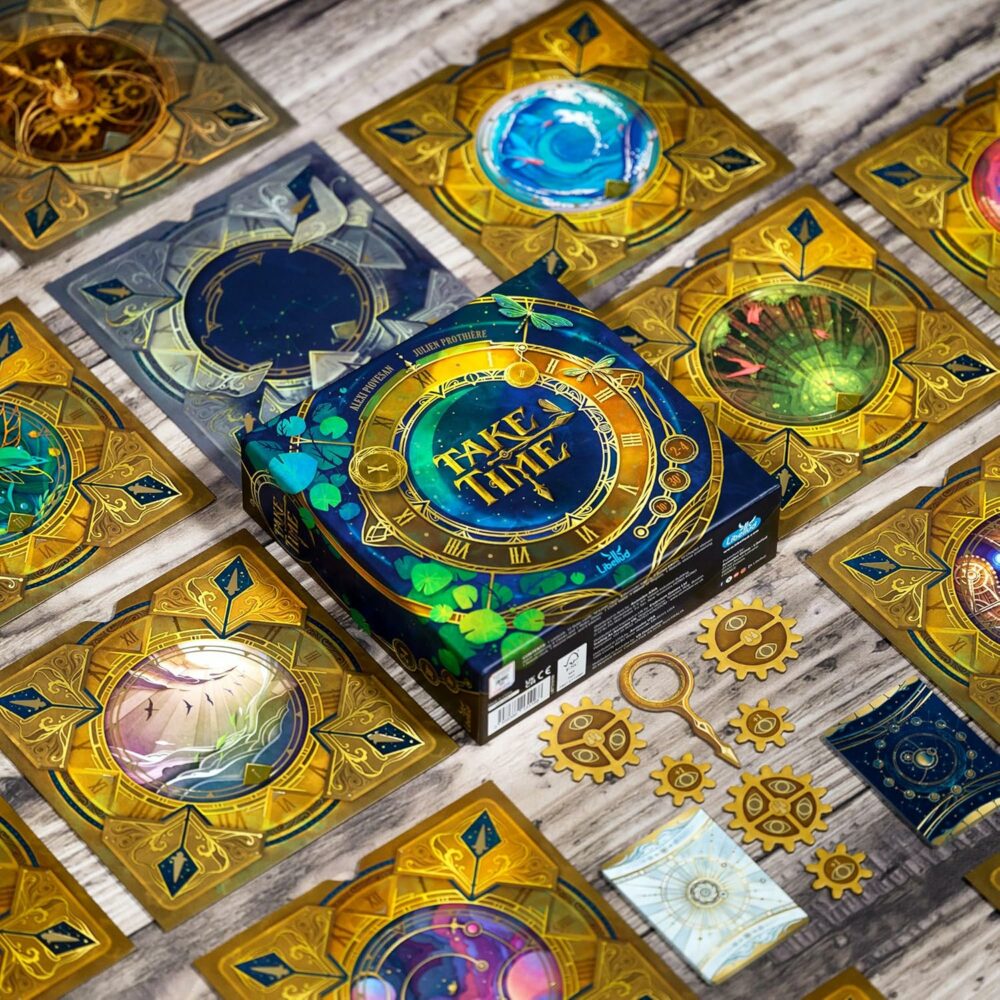
Each clock will have specific rules represented on the clock face through symbols. But in general, puzzles require that each clock segment has at least one card played on it, that the segments have larger and larger number sums as you work around the clock face, and that no segment’s card value exceeds twenty-four.
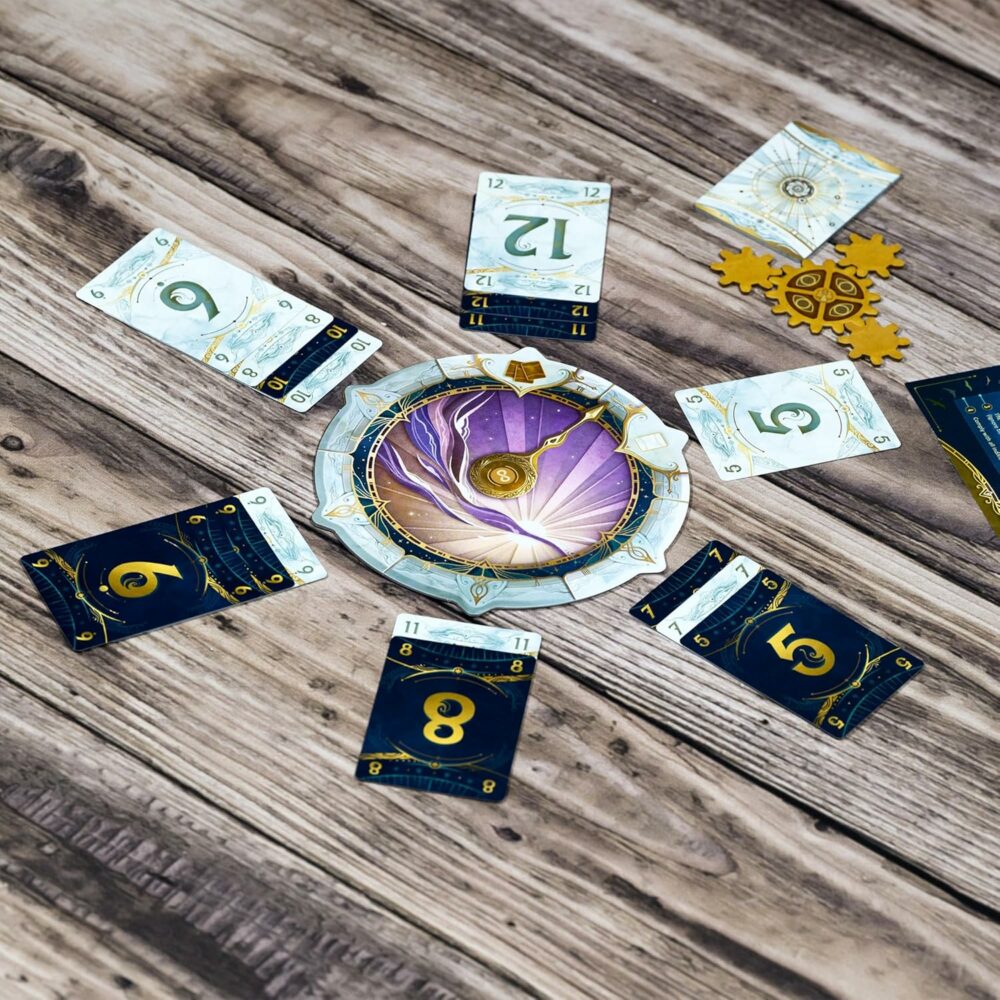
Each puzzle of Take Time is played in two steps. In the first, players have their cards but are not allowed to look at them. Here they will look at the more specific rules of their clock face and discuss what their strategy should be. Obviously it will be impossible to get into the specifics here without knowing what each player has in their hand. Instead, players will talk about their general strategy; what they would like to see happen if their cards cooperate.
For the second step, players will pick up and look at their cards, but are forbidden to communicate in any way. In this step there is no speaking, no sign language, not even a raised eyebrow. Players silently play their cards face down around the clock face and hope that all of the players will manage to fulfill all of the clock’s goal.
The puzzle is over when all of the cards are played and flipped face-up to reveal their numbers. Here players will figure out each clock segment’s sum and determine if they have succeeded in each of the clock face’s goals.
Should I Buy This Game?
I have many, many good things to say about Take Time. It’s challenging yet fun. It’s simple, but won’t get boring. The puzzles aren’t the kind that get boring to solve a second or third time, the art is gorgeous and immersive. And possibly best of all, games aren’t very long. You can sit down with Take Time and play for hours and hours on end, or you an play through just a few clock-faces and move onto something different in half an hour.
If you enjoy puzzle games, this is a great addition to almost any game shelf. Not-board-gamers would enjoy this as much as a seasoned gamer, and even kids could have a good time solving these puzzles.
Please note that BoLS may earn a commission when you purchase through links on our site.
Don’t Miss:

Read more at this site