

Competitive gamers, don’t even bother. Betrayal at House on the Hill will make you rage. But for the rest of us, it’s a fun experience.
I’m incredibly non-competitive. I prefer cooperative games or ones with a great narrative. And that’s why Betrayal at House on the Hill is one of my favorites. It’s weird, janky, poorly balanced, and one of the best times you’ll have hunting down your friends when you suddenly remember you’ve been an alien this whole time.
Betrayal at House on the Hill is a horror-adventure board game that puts you and your friends right in a spooky haunted house. The doors and windows have all locked behind you, weird stuff is happening all around you, and at any moment someone will trigger the big monster to come out of the woodwork and make terrible things happen. But the only way out is through…. through this always-changing haunted house.
| Quick Guide | |
|---|---|
| Mechanics | Dice rolling, modular board, role-playing |
| Players | 3-6 |
| Playing Time | 60 mins. |
| Similar Games | Star Wars: Rebellion, Gloomhaven |
| Publisher | Avalon Hill, Wizards of the Coast |
Betrayal at House on the Hill Overview
The game is broken down into two separate and distinct phases. In the first phase, the players are all working to explore the labyrinthine mansion. This is done using a tile-placement mechanic, where players place random room tiles with each new room they enter.
Most rooms have some event, item, or Omen. The Omens are the big deal here. Once a certain number of Omens have been found, the Haunt occurs. This moves the game into the second phase of the game.
One of the players, as determined by the scenario guide, will turn traitor. From that point on, it’s that player against the rest. The traitor player is encouraged to leave the room to read their own scenario guide because both teams now have their own secret victory condition.
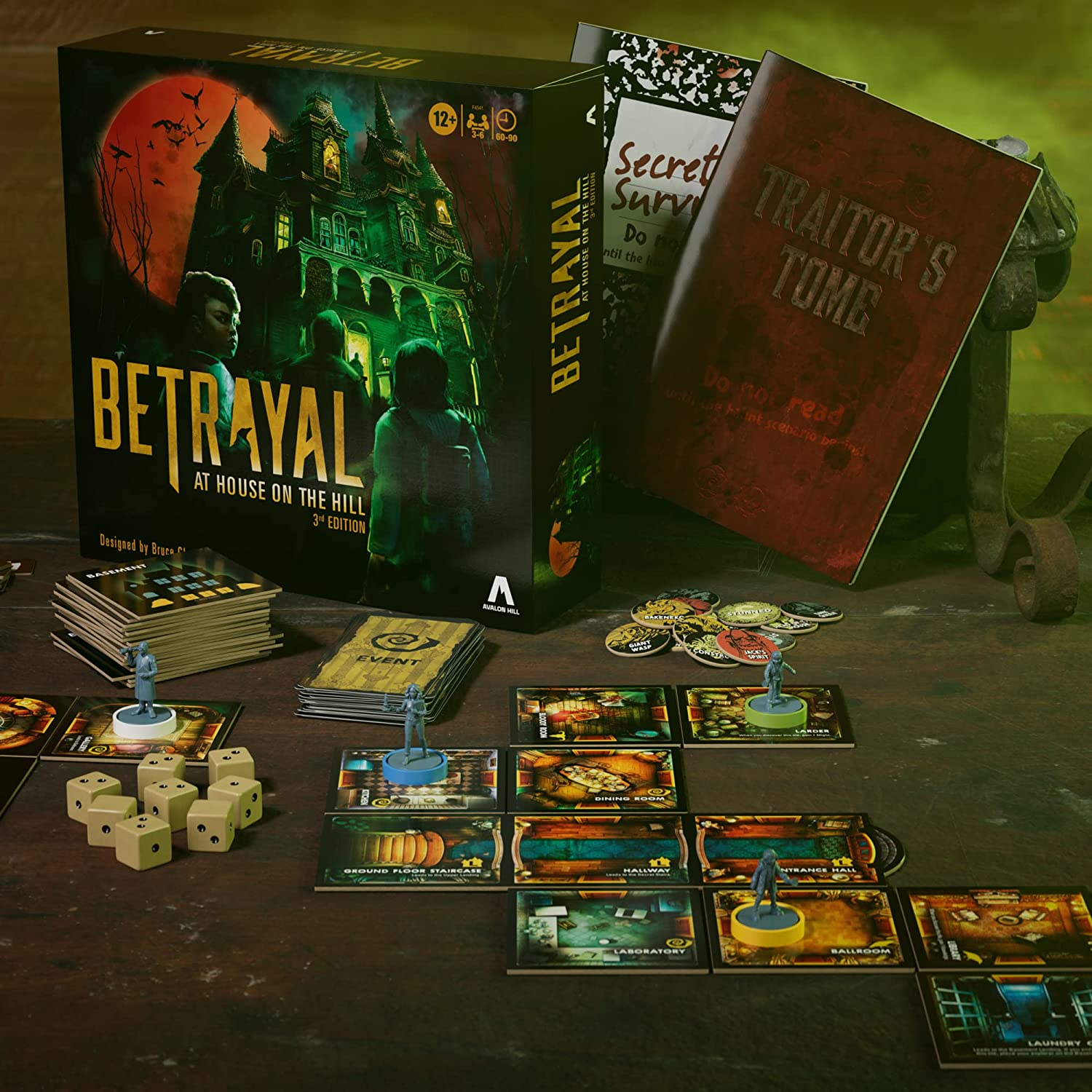
This second phase of the game is always completely wild. Standard rules and game balance get thrown out the window in favor of pure madness and fun. This is where Betrayal at House on the Hill loses a lot of people, and I can understand why.
If you’re easily disappointed by mechanics that feel one-sided and unfair, this game isn’t for you. But, if you can laugh at the absurdity of how quickly everything you carefully planned becomes unraveled, you just might love Betrayal at House on the Hill.
How to Play Betrayal at House on the Hill
To begin a game, players must choose their character, take the corresponding token and stat tracker, and set each stat to their starting point. The stats are Speed, Might (physical), Sanity, and Knowledge (Mental), and character has different starting stats. Players will also lay out the house’s foyer, shuffle the various decks of cards, and the deck of room tiles.
Each turn, players may move their character a number of spaces or rooms equal to their speed at that time. For example, Ox starts with a base speed of 4, so he can move up to four rooms in any direction. But if he were to take physical damage and reduce his speed, he may only be able to move two or three spaces. For every new room they enter, players will draw a room tile from the top of the stack and place it where the next room will go.
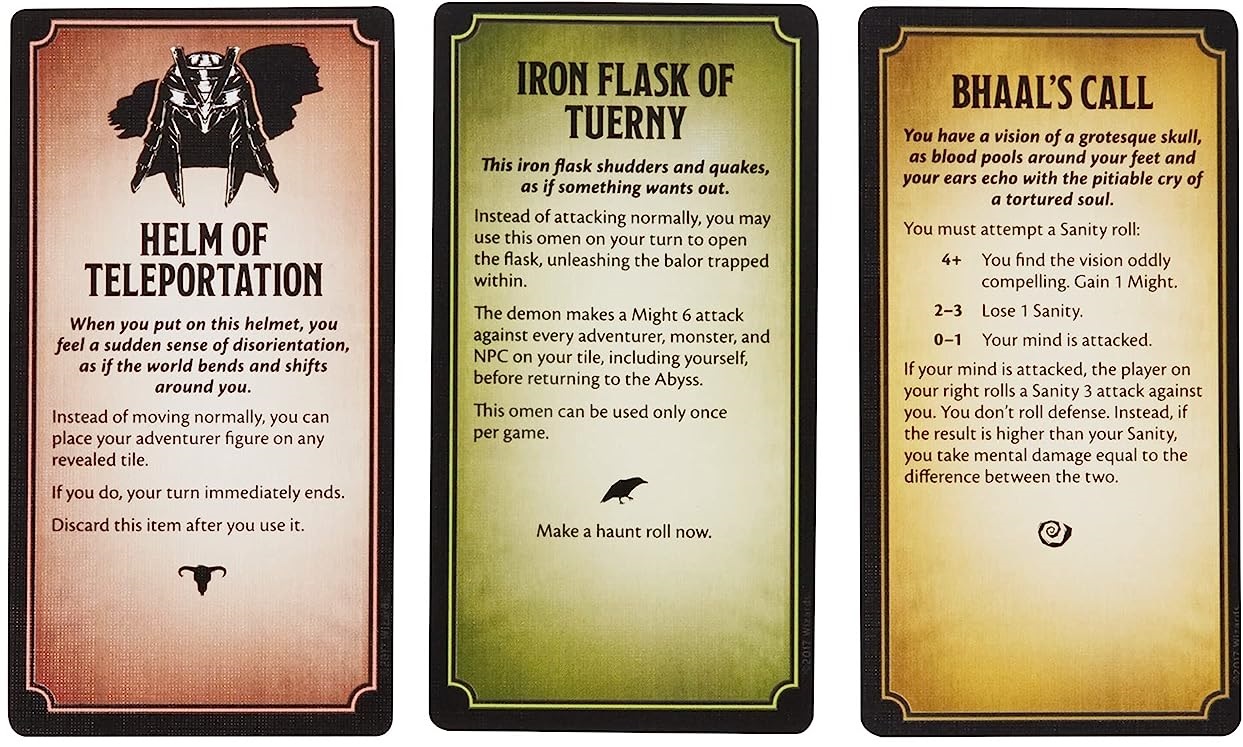
Many rooms have markings in the corner signifying a card that the players must pull the first time they enter the room. These cards may give you a special or helpful item, or may make you test your luck by rolling some dice and seeing if your character gains—or loses—any mental or physical health. But some rooms are marked with omen cards.
These are, by and large, the same, except that they have a chance of triggering the final haunt. Players will roll dice to determine if the haunt is about to begin, and when it does, they will flip to the right page in the game book to see which randomly selected monster they are under attack from and work together to meet the haunt’s objective or succumb to the attacking monster.
Should I Buy This Game?
Betrayal is quite literally my favorite board game. If you’re at my house and a game is suggested, there is a very good chance I will say, “Ooo, what about Betrayal?” And often, it gets played, because it’s fun. I love this game, and I’ll always recommend it to people. But it does have a few drawbacks that some may find annoying. Still, even with those criticisms, the Betrayal has massive replayability, a great use of tension, is easy to learn and teach quickly, and is especially fun for competitive groups of friends who don’t mind (lovingly) turning on each other a moment’s notice.
And it’s on sale right now – so it’s a great time to add it to your collection.
Please note that BoLS may earn a commission when you purchase through links on our site.
Don’t Miss:

Matt has loved games of all kinds his whole life: board, video, war, roleplaying, and card. He’s worked as a writer for BoLS since 2017.

Read more at this site