

February 1983. As we step into a new year of gaming Ian Livingstone wonders what might come next. With Treasure Trap starting (or at least publicising) live gaming, what might come next. I imagine he didn’t predict the array of content creators and live streaming that is on the way in a few years. We were also going to have to live with plenty of rubbish portrayals of D&D on telly and Mazes and Monsters before we got Stranger Things too.
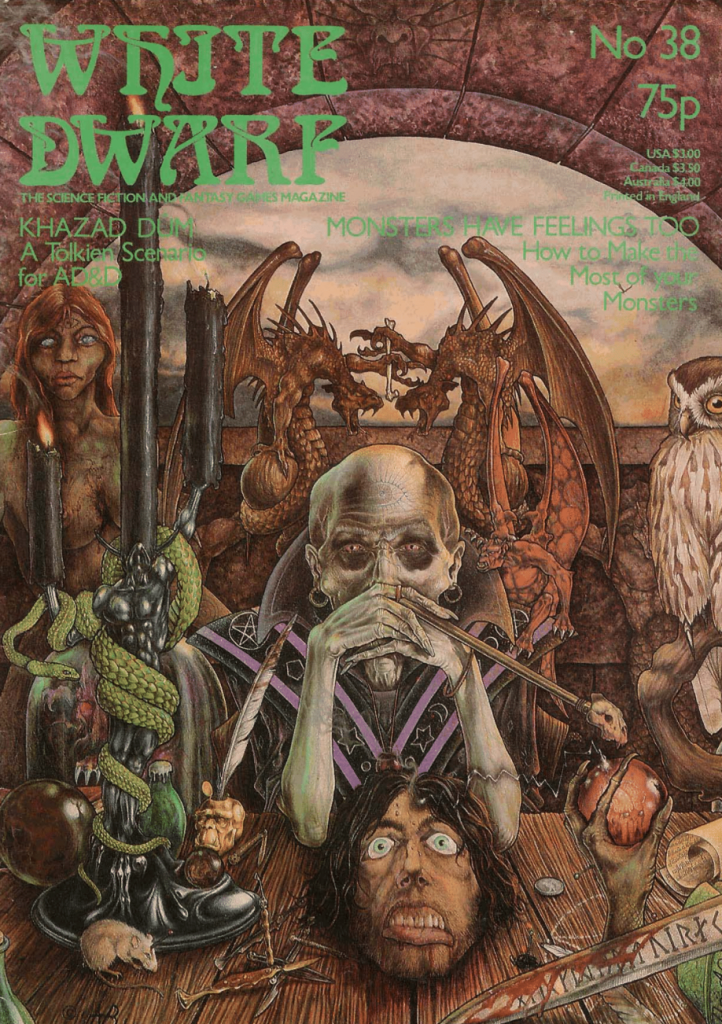
On the Cover
A wizened sorcerer sits at a desk in his lair surrounded by the tools and creations of his art. A serpent winds round a black candelabra, a homunculus whispers in his ear, twin dragons fight over a bone behind him and an empty eyed woman stands waiting at his shoulder. There is also a severed head on his desk in front of him, which might either be a new project or a warning to whoever he is facing. This is the second of Nicolas Biddy’s three covers. He did issue 30 and will be providing the cover for next month’s issue as well.
Features
An Introduction to Traveller Part III, Scenarios (Andy Slack): I think this is my favourite of this series so far, as it has a lot of very good advice for any adventure. Not only does Andy Slack talk about the usual set up of a patron getting the PCs to do a job, but he also discusses why. Why pick the PCs? Can the patron trust no one else? Is it just because they are expendable, or just because strangers might be more trustworthy? He also takes a look at the potential rewards and what might tempt the PCs to do the job instead of just walking away.
Questworld (Oliver Dickinson & Bob McWilliams): A brief look at a new (non-Glorantha) world setting for Runequest. Apparently Greg Stafford decided Glorantha was his baby so he was going to be the one to write it. So Questworld was a new setting that anyone (at least at Chaosium if not further) could create and adapt. The boxed set will be out later this year but it won’t quite prove as promising as expected. Robin Laws’ rules for Heroquest will become known as Questworlds later in 2000, but I don’t think they are quite the same. Tell me if you know more!
Khazad Dum! (Lew Pulsipher): Lew Pulsipher puts his money where his mouth is after his introduction to D&D with a scenario for new players. The idea, drawn from his articles, is that crossing Khazad Dum is a good option for newbies as they are likely to know the story and the characters. It also has a clear goal: to get across to the east gate. Nice work and easily adaptable to a more standard gaming set up too.
Monsters have Feelings Too (Oliver Dickinson & Graeme Davis): These days a title like this would bring out the “OMG it’s all woke” mob. But this is actually about giving your monsters motivations not therapy. It’s a pretty basic idea these days but quite new in 1983. It advises the DM to treat the monsters as if they have some thoughts and feelings, so not all of them will be willing to fight to the death (for example) and any intelligent monster will only attack if it has a good reason to, not just because some player characters walk past its lair.
Regulars
News: A fair amount of new Runequest figures are out this month, as well as the results of the Judge Dredd caption competition (but you’d have to see the picture for it to make sense!). GDW is finally releasing the second part of the Traveller Library in case you’ve needed N-Z recently. They also have a Traveller adventure called Nomads of the World Ocean on the way and some more World War II wargame releases. Steve Jackson is expanding Car Wars with what I suspect is Truck Stop, and starting Autoduel Quarterly magazine. It’ll arrive in 1983 and continue until 1992, which is pretty good going. Hero Games is expanding Champions with a general supplement called Champions II, and Task Force Games has more on the way for Star Fleet Battles. Flying Buffalo has a new subsidiary (or partner) called Blade who will be producing Tunnels and Trolls and Nuclear War. They are also creating a new Noir style RPG called “Mercenaries, Spies and Private Eyes” which may be the first of that genre (and it will do pretty well).
Letters: Ah, Don Turnbull, you did stir up a hornet’s nest. Most letters this month are upset as his previous letter criticising the necromancer. Sure, the “how dare you tell me how the game should or shouldn’t be played” are valid. But I’m not sure it’s a flex to insist you all regularly play horrifically evil characters! We also have a reappearance of the old refrain of “can you cover some other games?” which gives the editor the opportunity to mention plans to broaden the magazine’s remit. Lastly there is the very long homebrew letter over armour class. Apparently the system isn’t very realistic (and there I’d agree wholeheartedly, but it is what it is). Their answer is a very long detail on how to add or subtract from AC by as little as 0.5 in a wide variety of very specific weapon and attack options. Isn’t D&D combat long winded and time consuming enough?
Starbase: No Starbase again this month. I suspect it is alternating with Microview while Andy Slack is busy with the Introduction to Traveller articles.
Runerites: Tired of having to join a cult for ultimate power? Fear not! This issue adds Spirit Lords, unaligned demigods who might be talked into offering some no strings power for a few favours. A nice idea you can slide into other fantasy games.
Microview: With so much talk of “computer assisted D&D” this issue Noel Williams takes a look at what computers can do at the gaming table. These options range from dice roller to searchable rulebook and number crunchers. Prophetically, he pretty much covers all the things that they are being used for commonly in games now.
Treasure Chest: We’re back to a collection of new spells this issue, and who doesn’t like that. We have Wall of Electricity, which is a nice idea. Isolation cuts off all your senses so is nicely horrific. Flamebrand gives your sword an extra 2d6 flame damage (pretty punchy, even for a 4th level spell). Bestow Magic Resistance does just that, and while weak at low levels is horrifically powerful at very high ones. Finally Evil Aura is my favourite, making you appear evil to detect evil magic when walking into the evil villain’s lair. Note that its reversible for when the villain fancies coming to you!
Fiend Factory
No adventure, but a solid theme this issue as we get a collection of faerie creatures to follow up on last issue’s faerie article by its author Alan E Paull. Double points to Mr Paull as many are also interesting encounters rather than just combats, drawn as they are from folklore:
- Gwyllion Telepathic information brokers who can be very misleading if not paid properly in gold.
- Bogles Quite a nasty type of goblin who is exceptionally good at hiding.
- Redcaps An old favourite psychopath of the fey lands, a form of ogre that likes to dip his cap in the blood of his victims.
- Bean Nighe One of the “washerwomen at the ford” type fey who are often vengeful ghost/hag creatures.
- Fay Stirge A seductive and beautiful fey vampire woman who can turn into a huge flying mosquito-like stirge. Your players won’t suspect that!
- Spriggans Another form of goblin who love to dig deep in mines for the fun of it.
- Duergar A dark skinned form of dwarf/gnome skilled in illusion magic.
- Phooka Another old favourite shapeshifting trickster. They love to change into a riding animal and trick people into mounting them so they can take them miles away and throw them off somewhere unpleasant.
- Black Annis A cannibalistic winter hag creature who wields a very dangerous magic staff.
Open Box
This month’s reviews are:
- The Traveller Book, Revised RPG Corebook (GDW) While we loved the 3-4 books in a box, GDW seems to think its time for a more cohesive all in one rulebook. Oddly you don’t seem to hear much about this one, perhaps it didn’t do so well as the tiny books or maybe everyone had Traveller by now! Anyway, its basically books 0-3 collected together with a couple of minor revisions.
- Dicing with Dragons, Gaming essays (Routledge & Kegan Paul) Similar to “Heroes for Wargames” this book looks at what RPGs are (and what they are not!) and what is available in the industry now its large enough to differentiate itself from Wargames. Its written by Ian Livingstone so the author knows what he’s talking about. I wonder if it had anything to do with inspiring Shannon Appelcline to take up the torch with his extensive (and fascinating) histories of gaming.
- Traitor and The Spirit Stones, RPG Adventures (FASA) Another case of one company writing for another company’s game. This time FASA gives us two adventures for Chaosium’s Thieves world setting. With Judges Guild doing D&D and Games Workshop doing Traveller supplements it seems the 80s were an age of people sharing settings. Shame that’s not the case now, although it is hard to manage, but we do have community content which is often much more open if not available for licenced settings.
Read more at this site