

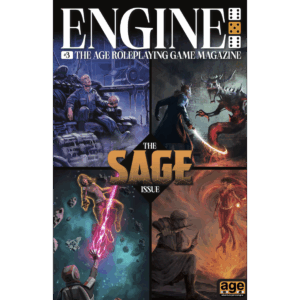
Preview the SAGE rules in Engine issue 3, available now!
I wanted SAGE to optimally do what many AGE System fans do already: customize the system to fit a setting of their own design, tailoring game mechanics for their own use. I had a vague notion of how to do this for game systems, but about midway through I realized that it’s hard to pick game mechanics if you’re struggling to figure out what to say about your setting. Worldbuilding has so many facets it’s a hobby of its own, but I want you to actually play and run SAGE.
So, I thought back to how I create settings, and how I, as a Real-Life Game Designer, write and develop these for publication. I especially thought of the advice I give other writers when I’m developing their work, or they just want advice. After giving it some thought, I did for your setting what I would do for a published setting: I wrote you an outline.
That’s the first part of the SAGE build process. I don’t pretend it’s innovative, but it works. Instead of providing vague advice, you’re getting topics, areas I want you do dig into, and yes, even wordcounts. We’re going to put it all on a form, for which the setting is the first part.
Why though?
Beyond creating focus, wordcounts exist to let you know when to stop. We’ve all seen RPG supplements where one part or another weirdly runs on. Sometimes this is because of overwhelming interest, but sometimes it’s because you’re spinning your wheels. And regardless of how deep you’re into the setting, giving a suggested length limit pushes you to finish it. Get it done, get your functional setting, select the rules for it, and play. Thus, the Story Build outline takes you through these facets:
- Summary: Mission statement and maybe elevator pitch, rolled into one, to anchor you in core ideas.
- Setting: Peoples, factions, and other matters of raw fact in your setting.
- Characters: This is an easy one—it’s where you put summary information about the protagonists people will be playing.
- Premise: Where you answer, “What makes stories happen in the game?” Here’s where you look for impetus you can constantly draw on throughout play.
- Style: The esthetic and emotional basis of play. Genre, mood, tropes, inspirations.
- Premiere: The kickoff that brings characters to the start of the story.
Each section comes with very specific areas to focus on within these topics—again, just as it would in an outline, except with a bit more formality in the writing. However, I won’t be judging your work, and that gives you more freedom than when writing for publication. Point forms, shorthand, sticky notes, and even ignoring my outline (It’s good though?) are all fine.
However, once I decided to do this, I realized the game itself was written in that standard Royal-We manner, which, to be sure, has many excellent reasons to exist, but doesn’t feel so much like one writer talking to another. That’s why I revised the text after, to make it more conversational, and even speak to you in the first person, like I’m doing now.
There’s also the System Build stage of making SAGE your own…but that’s not as suited to an article like this. You’ll see it when it comes out!
Missed the previous SAGE Design Diaries? You can catch up on articles 1 through 7 right here!
Read more at this site