

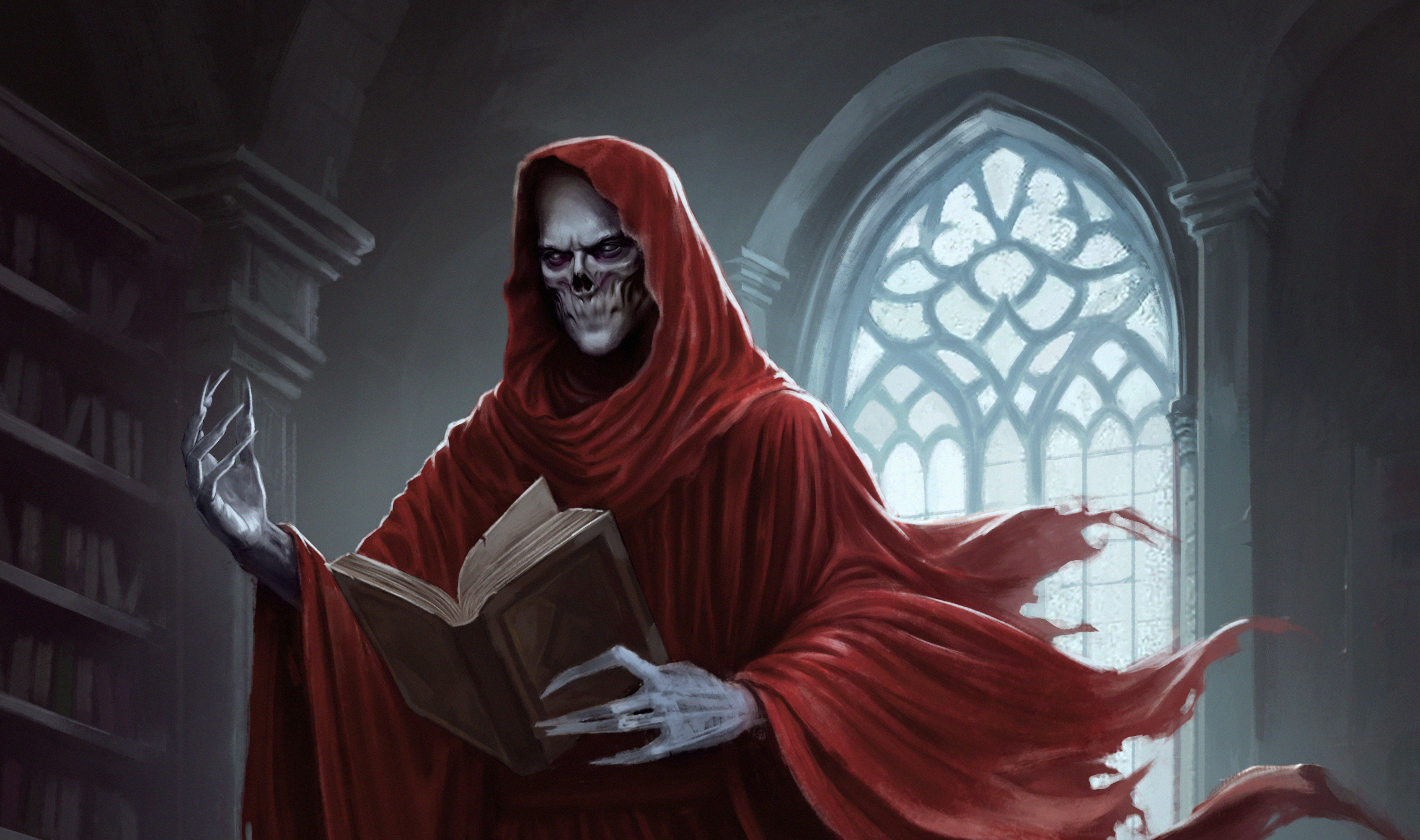
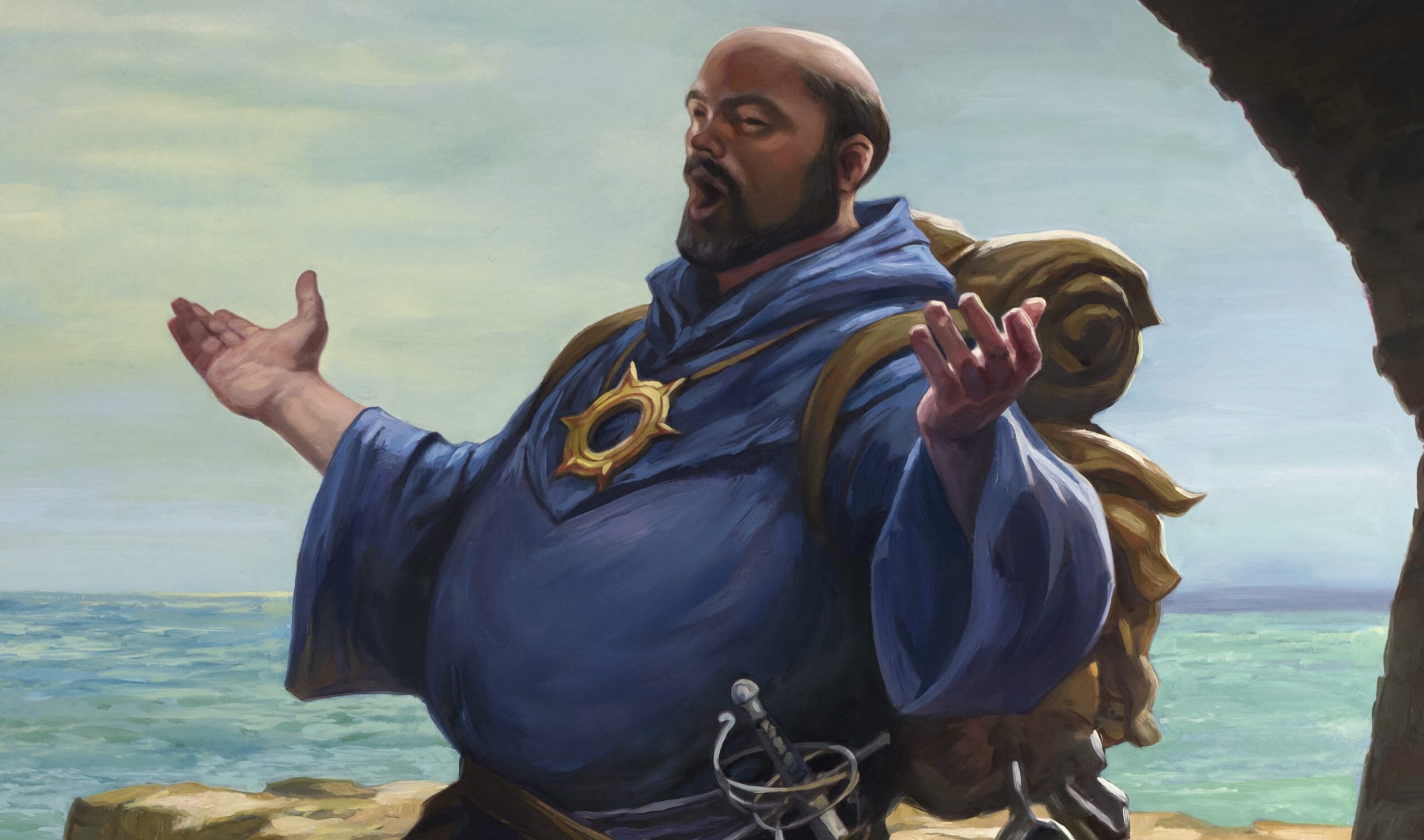
The upcoming hardcover Secrets of the Tome contains a plethora of new arcane-themed character options. Amongst those are archetypes—subclasses—for the main spellcasting classes. In this preview we’ll look at the archetypes (subclasses) to be found in Secrets of the Tome. Next week, we’ll take a look at the NPCs who exemplify each, such as Professor Omega: Purveyor of Patent Medicines, Brother Joney: Wandering Storyteller, Verena Astacal: Warlock of the Chained King, and Chilblain: Lich Librarian, In the meantime, don’t forget to follow Secrets of the Tome on Kickstarter.
The archetypes (or subclasses) in this book are lost to the world—or nearly so. They represent forgotten traditions and hidden secret orders. Perhaps the only way to join such an order is to find and study an obscure manuscript. Or perhaps one or two potential mentors may still walk this world. Or maybe the only remaining teachers of these old traditions are within the Wasteland, where secrets go to die.
Although the subclasses in this book are rare in the game world, the Narrator and the players can decide together just how hard they are to obtain. Your players might start play as the last heirs to these old traditions. Or it may be that a character can’t take one of these archetypes until they complete a quest. In the latter case, when such a quest is complete, a player can switch to their new subclass without penalty.
For each of the archetypes in this chapter—for the artificer, bard, cleric, druid, sorcerer, warlock, and wizard—we also present an NPC who embodies this archetype: a member of that order who has secrets to impart. We’ve suggested a place where each of these NPCs might be found in the Wasteland, but of course in your game you may place them wherever you want. Perhaps Chilblain the lich’s lair isn’t in the Wasteland at all, but on top of a mountain, in the depths of a dungeon, or even in the stacks of a famous library.
In case your characters meet one of these NPCs, we’ve included notes on what they might offer in a bargain, and what they might want in return. We’ve included stat blocks as well, just in case negotiations don’t go as planned.
Artificer: Huckster
Many artificers are driven by a desire to advance the sum of knowledge or unlock the secrets of the universe. That and a copper piece will buy you a candle. You got into the artificer business for the money. Along the way, you sold a lot of patent medicines, get-rich-quick schemes, and marvelous inventions without caring very much whether they worked as advertised.
These days you’ve turned over a new leaf. Now that you’re an adventurer, of course your first priority is saving the world. After all, no world means no customers! But just because you’ve learned some new tricks doesn’t mean you have to forget your old ones: you still know quite a few methods for separating a fool from their gold.
Bard: Talespinner
Talespinners study oral traditions and the vast scope of knowledge that was never committed to writing. They carry the spirit of generations with them, calling on them for wisdom and aid. Not quite necromancers, they nonetheless straddle the bridge between those living and those who have passed on, keeping traditions and tales alive.
Cleric: Moon Priest
Moon priests are servants of the light who operate in the dark. In forgotten ages past, the moon and its connection to wolves was revered as the great protector of the night, and moon priests traveled the byways between communities hunting hags, fiends, and worse that slunk through the shadows with fang, claw, and their signature iron whips. Denounced as witches by overzealous inquisitors, they eventually faded from the world.
Druid: Reverent
Some gods may wear the trappings of nature, but nature itself is a force far more deserving of reverence and sacrifice. Even amongst the ancient origins of druidic lore the circle of reverence is old, a relic dating back to times of cold winters and short lives. Nature gives, nature takes, and nature’s price must be paid by others. They learned that through reverence and spilt blood the sun could be made to rise again, and a mortal could wear the trappings of nature just like the gods.
Sorcerer: Constellation
The stars call to you. Something deep within you shimmers with their light, and it may even physically manifest as a twinkle behind your eyes or points of light tracing celestial geometry across your body. Regardless of its appearance, it imbues you with a power which bleeds forth from the night sky itself, allowing you to glean insight from the stars, and call down their wrath upon foes.
Warlock: Chained
In ancient times the Chained King was a tyrant, a ruler, perhaps even an emperor of some distinction. But he has been trapped for so long that all that remains is a gaunt figure, a crown, and the shackles that bind him. He seeks a freedom he can never possess, empowering others to seek his release—a fruitless venture, because he is, and can only be, the Chained King.
Warlocks who seek the boons of the Chained King gain the power to bind their foes and free themselves, and are often given nonsensical directives to oppose enemies of the Chained King that may or may not exist. The final goal, of course, of any chained warlock is to free the Chained King himself, in exchange for bountiful rewards that will never materialize. The Chained King awaits, always.
Wizard: Undying
Many wizards are content to pass on at the end of their natural life, gaining immortality through fame and their magical accomplishments. Not you! You plan to gain immortality by not dying—or at least not permanently dying. You are determined to become a lich.
The path to lichdom is a hard one. There will be sacrifices along the way (maybe literally!) But think of all that extra time you’ll have to study!
Read more at this site