

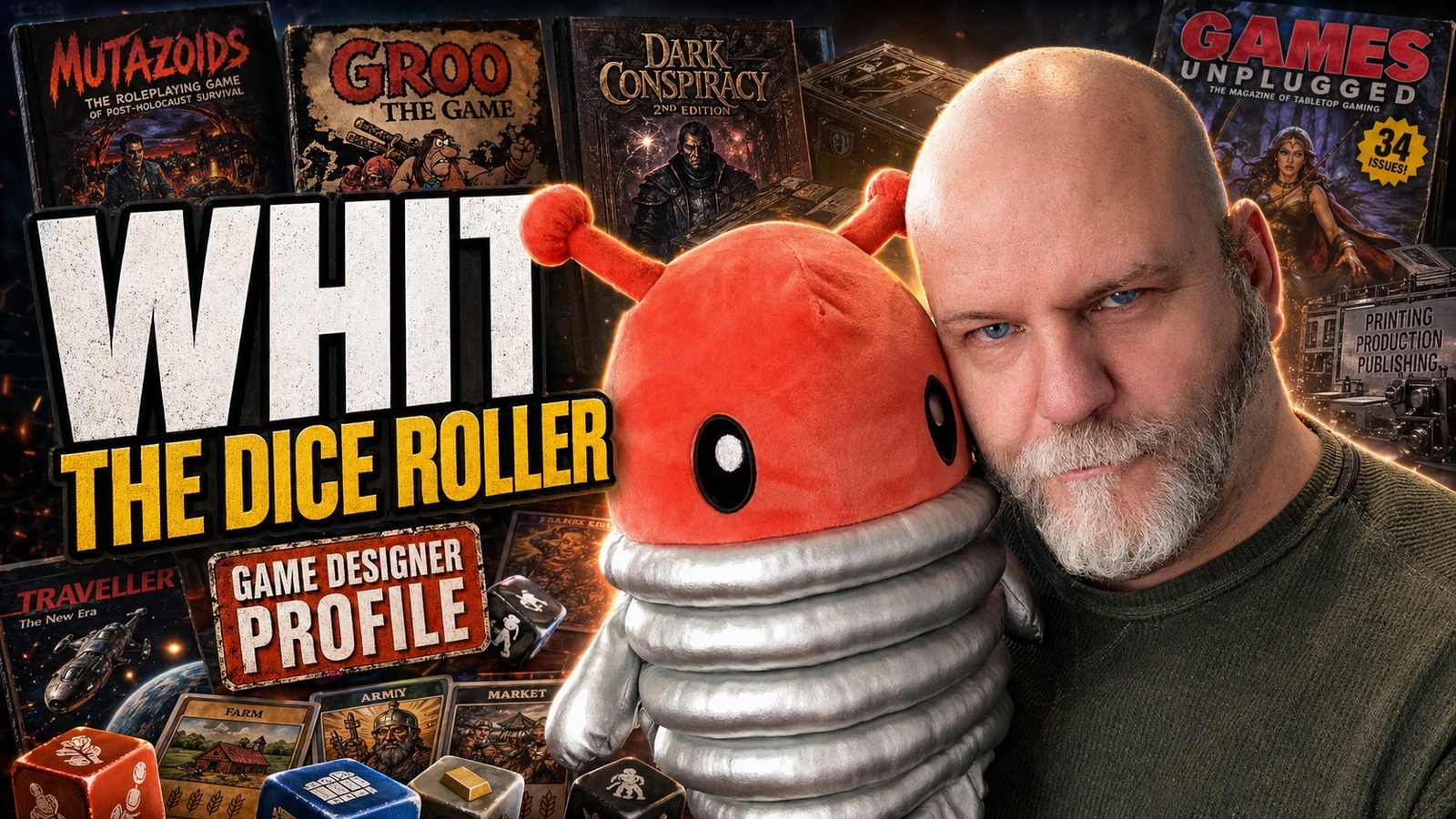
Ken Whitman is behind the site, and has his own Ai-created biography
Ken Whitman, a man whose reputation in the gaming industry is controversial at best, is behind a new website called ‘4 Pillar Games‘. The website purports to be a record of influential game designers and companies, as well as an RSS-powered news section and a–currently empty–storefront which invites game publishers to apply for inclusion. The storefront tab appears to have vanished sometime in the last few hours.
While Whitman’s name is not mentioned on the site (other than in his own biography), his name is in the metadata, indicating his ‘authorship’ (a strong term when referring to RSS feeds and AI generated content). Three others were publicly named on the site in a now-removed ‘About’ page: Don Perrin (Traveller, Sovereign Stone, Dragonlance), Tony Lee (Games Unplugged) and Reece Wardrip (Spycraft, Twlight:2013).

This page has now been removed from the site
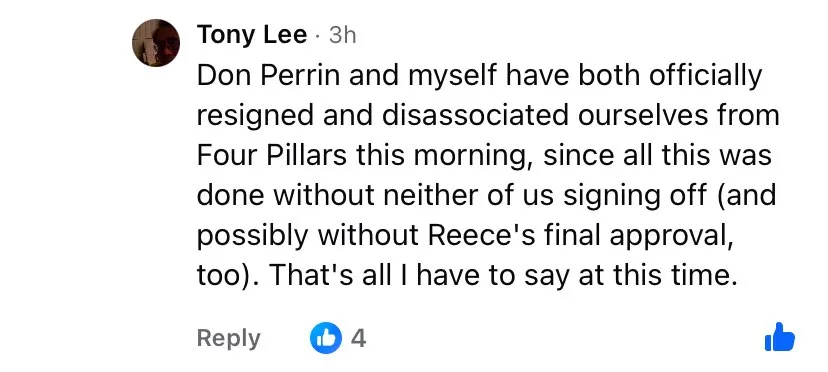
Both Perrin and Lee have now reportedly left the project, stating that the site was made without their approval.
The bios are all written by AI, and all follow a similar format: An AI-generated image of the person in question, many of which are laughably bad, and a one-page summary. Many game designers have publicly stated that they did not consent to their inclusion in this ‘directory’, although some have found amusement by mocking the AI-created images of themselves. Evil Hat’s Fred Hicks commented on his own entry:
- Haven’t looked this young in 20 years.
- Gave no legal permission to use my likeness in this image.
- Gave no legal permission to use trademarked logos placed on incorrect product images & layouts shown here.
- Them Fate Dice are jank, yo.
- Contemplating legal action.
- Enjoy, mother****er.
Many other game designers have expressed similar sentiments. Chris Bisset was more confrontational, saying “Hey uhhhhh if you make AI slop images of me and I meet you in person I’m going to hit you full force in the throat, just as a little PSA”, while Grant Howitt asked “There’s so many pictures of me online. Why not use one of those instead of asking a computer to gin one up with a couple dozen extra wrinkles”. Cam Banks said “I sent this Reece Wardrip guy a message on LinkedIn to take down the AI slop photo of me and that AI-written bio. What a colossally lazy and insulting thing to do to people.”
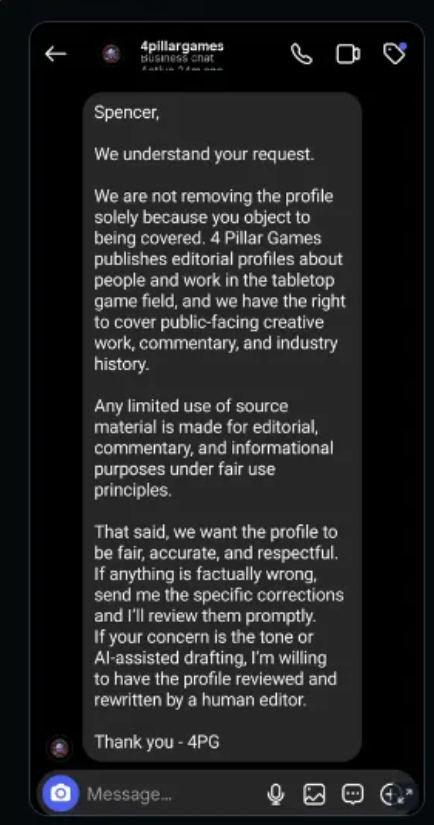
Some designers have asked to be removed, but have received a stock response from Whitman, such as the one below sent to Spencer Campbell of Gila RPGs.
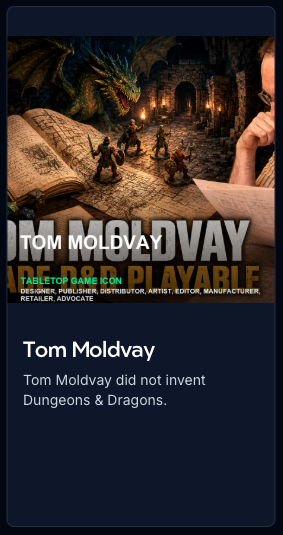
The designer summaries all read in a similar way, and one amusing aspect is that when you look at the menu of designers, which includes the first line of each summary, it looks a really weak diss track listing things that game designers did not do–we are usefully informed that “Jason Bulmahn did not invent d20 fantasy roleplaying” and that “Peter Adkison did not design Magic: The Gathering.” Here’s an informative list of other things those mentioned did not do:
- “Aaron Allston’s best ideas do not look like inventions anymore.”
- “Peter Adkison did not design Magic: The Gathering.”
- “Scott Almes did not make small games because small was cute.”
- “Cam Banks did not ask one universal question with Cortex.”
- “Jason Bulmahn did not invent d20 fantasy roleplaying.”
- “John Blanche did not make fantasy darker by turning down the lights.”
- “Kris Burm did not make one abstract game and move on.”
- “Jolly Blackburn didn’t set out to define tabletop gaming culture.”
- “Milton Bradley did not set out to become the father of American board gaming.”
- “Rich Baker did not make Dungeons & Dragons by inventing from empty air.”
- “Richard Berg did not treat history like scenery.”
- “Sydney Beckman does not teach Evidence like a museum of rules.”
- “Tim Beach was not the loudest name in the TSR building.”
- “Tim Bradstreet did not make Vampire: The Masquerade by writing clans, disciplines, dice pools, or city politics.”
- “Wolfgang Baur did not build Dungeons & Dragons.”
- “Bill Bridges did not build his reputation by making neutral rules.”
- “Clyde Caldwell did not make Dungeons & Dragons darker by writing a rule.”
- “Isaac Childres did not make the dungeon crawl friendlier.”
- “Graeme Davis did not make fantasy darker by adding more monsters.”
- “Ryan Dancey’s biggest contribution to tabletop games was not a monster, a setting, a rulebook class, or a clever combat mechanic.”
- “Jay Dragon does not treat rules like invisible plumbing.”
- “Jeff Easley did not make his deepest mark on tabletop gaming by writing rules.”
- “Ron Edwards did not ask whether a role-playing game could tell a good story.”
- “Larry Elmore did not make his deepest mark on tabletop gaming by writing a combat table.”
- “Amanda Lee Franck does not treat the map as a handout.”
- “Fred Fields did not shape tabletop gaming by writing a rule.”
- “Mike Fitzgerald did not need to invent a new card game to make people lean forward.”
- “Sean Patrick Fannon did not build the engine.”
- “Ed Greenwood did not start the Forgotten Realms as a product line.”
- “Joseph Goodman did not ask what old Dungeons & Dragons looked like.”
- “Goro Hasegawa did not invent the idea of flipping discs on a board from nothing.”
- “John Harper did not invent fiction-first roleplaying.”
- “John Eric Holmes did not invent Dungeons & Dragons.”
- “If the d20 system is a cathedral, Amanda Hamon is not the person who poured the foundation.”
- “Christopher Jeansonne does not treat media history like a timeline.”
- “Jeremy Jarvis did not become important to tabletop fantasy because he painted one famous picture.”
- “John Kovalic did not make games look serious.”
- “Seiji Kanai did not prove that small games could exist.”
- [Billy Littlepage is] not attached to famous boxed games.”
- “Lenard Lakofka did not just draw a dungeon and wait for adventurers to kick in the door.”
- “Steven S. Long did not invent the HERO System.”
- “A Todd Lockwood dragon does not look like a symbol.”
- “Tom Lehmann did not become Tom Lehmann when Race for the Galaxy appeared.”
- “Angus McBride did not paint fantasy as escape from history.”
- “Marc Miller did not give science-fiction role-playing a plot.”
- “Kim Mohan did not become important to Dungeons & Dragons by standing in the spotlight.”
- “Roger E. Moore did not just write for Dungeons & Dragons.”
- “Tom Moldvay did not invent Dungeons & Dragons.”
- “Gavin Norman did not become important by inventing a new fantasy engine.”
- “Scott Palter did not create Star Wars.”
- “Charles S. Roberts did not set out to create a hobby.”
- “Volko Ruhnke did not approach conflict like a duel.”
- “Carl Sargent did not make dark fantasy by turning down the lights.”
- “Jack Scruby did not become famous because one rules system conquered the hobby.”
- “R. A. Salvatore did not begin by redesigning Dungeons & Dragons.”
- “Ethan Skemp did not create the World of Darkness.”
- “Steve Stone did not make his deepest tabletop mark by building a dice engine.”
- “Robert J. Schwalb did not build his reputation by making fantasy darker.”
- “Francis Tresham did not flood the hobby with designs.”
- “Jason Tocci did not make a tiny RPG because he had nothing to say.”
- “Donald X. Vaccarino did not begin with a small idea.”
- “Michael Van Vleet does not usually build the engine.”
- “White Wolf did not begin as the company that made vampires cool.”
- “Dave Wesely did not sit down to invent roleplaying games.”
- “Jean Wells did not leave behind a long shelf of modules with her name on the spine.”
- “Ken “Whit” Whitman did not build his tabletop career like a man protecting one perfect system.”
Read more at this site