

Recently, we travelled to sunny Swindon in the heart of England to meet with Mongoose Publishing, where we met the staff, toured the offices, and interviewed everybody about life at Mongoose–including a long interview with CEO Matt Sprange covering the company’s history, goals, and work culture.
A small company with just 7 employees, but many TTRPG companies in this tiny industry cannot make that claim. 7 employees is well above average in the TTRPG sphere. Mongoose occupies a suite of offices located above a bed shop on a Swindon shopping street. It is unobtrusively signed–the door can be found down the side of the building, down an alley, leading to a set of stairs leading up to the two spacious rooms which Mongoose calls home. One of those rooms contains a kitchenette, a lounge area compete with sofa and a big screen, a large dining/gaming table, and a bunch of workstations, along with a corner partition for Sprange himself. The place is full of geek culture. Shelves teem with books, toys, and models, from a Ghostbusters proton pack to a full set of Fighting Fantasy gamebooks. The other room, equally large, is full of tables covered with 3D gaming scenery, a corner for stock, and a cubby area for recording videos.
Mongoose operates an in-person office. Matt talked about the company’s experience during lockdown, when everybody was working remotely. “We went into lockdown two weeks before it was official, because you could see what was coming,” he said. “The first thing we saw was productivity went shooting up.” I asked him why Mongoose–pandemics aside–chose not to work remotely, as many companies do. “The ability in a creative job to just turn around in your chair, tap someone on the shoulder, what do you think of this?” He talks of the constant back-and-forth of in-person interactions and how video technology cannot yet replicate that experience. The company as a whole talked about it, and decided as a group to return to the office.
Matt reminisced about the old days, when Mongoose worked like an efficient machine. “We were in a position… we could tell a distributor what day a book was going to come out six months in advance.” The company isn’t so strictly run anymore. “These days we don’t have deadlines anymore, we have guidelines which are inevitably broken every single time.” But, he insists, the books are better for it. The people are happier. The company is selling more books.

Mongoose shares a home-cooked meal every day
As a place to work, Mongoose feels like family. The employees take it in turns to cook a meal for the whole team each day. This also has practical benefits–“First, obviously, it saves the employees some money. It’s not very much, but it all adds up over an entire month. Also, it stops them getting McDonalds in. They’re gonna live longer now.”
The team all seem to love working there. Graphic designer Cassie Gregory joked “I love working at Mongoose because we get company cars and big bonuses.” But it’s not just the home-cooked meals, the company cars, and the decent salaries: they all take a pride in their work and get a sense of a achievement at a job well done. Layout artist Abby Mansion told us “Just control over my own products, and the fact that it’s a really supportive environment.” But lead writer Christopher Griffin probably summed it up best: “Every day, I just look forward to coming into work.” Or, perhaps, Matt Sprange himself, when he says “The best thing about working here? It’s not a real job.” As Mongoose’s newest employee, Natalie Miller, said: “The job advert seemed too good to be true!”
Matt also talks about the struggles of young people buying their own homes these days. “I wanted to try and find some mechanism for people to lead decent lives, to have a proper work-life balance, and actually enjoy what they do rather than dreading coming to work each morning.” Most of the staff are in the 20s or early 30s and are at the point in their lives where they are starting to buy their own homes. “The financial support… we get kind of access to a mortgage advisor”, said Abby Mansion. “And that really helped me buy a house a year ago.”
Company cars, home-cooked meals, a supportive environment, good salaries, employees who look forward to coming in to work–surely it doesn’t get better than that? Well, it turns out that it does! Mongoose is working towards an employee-ownership structure, where every employee owns an equal share of the company itself. Decisions are made as a group, albeit under Sprange’s experienced, guiding hand. Matt is enthusiastic about this topic–it’s not the first time he’s mentioned it to me. “I do get a bit evangelical about it when I talk to other company owners.” The employees themselves are also keen on the idea. “I do like the fact that we are striving to become an employee-owned company,” says Chris Griffen. “Means more to, as I call them, the young-uns here, since they will inherit this company. But I think it’s really cool that we all have such a stake in it.”
Mongoose has recently been acquiring a bunch of TTRPG properties, from Traveller to Dark Conspiracy to Twilight:2000 and 2300 AD. Traveller is, by far, Mongoose’s biggest product line, their bread-and-butter. They’ve been producing content for Traveller under license since 2008, but in 2025 they finally announced the full purchase of the IP from creator Marc Miller. “Before we bring out any new game or book, at least one person at Mongoose has got to be absolutely dippy about it.” Many of the current range are games Sprange played when he was younger. He talked about playing Paranoia as a teenager. “So I’m just doing the games I used to play.”
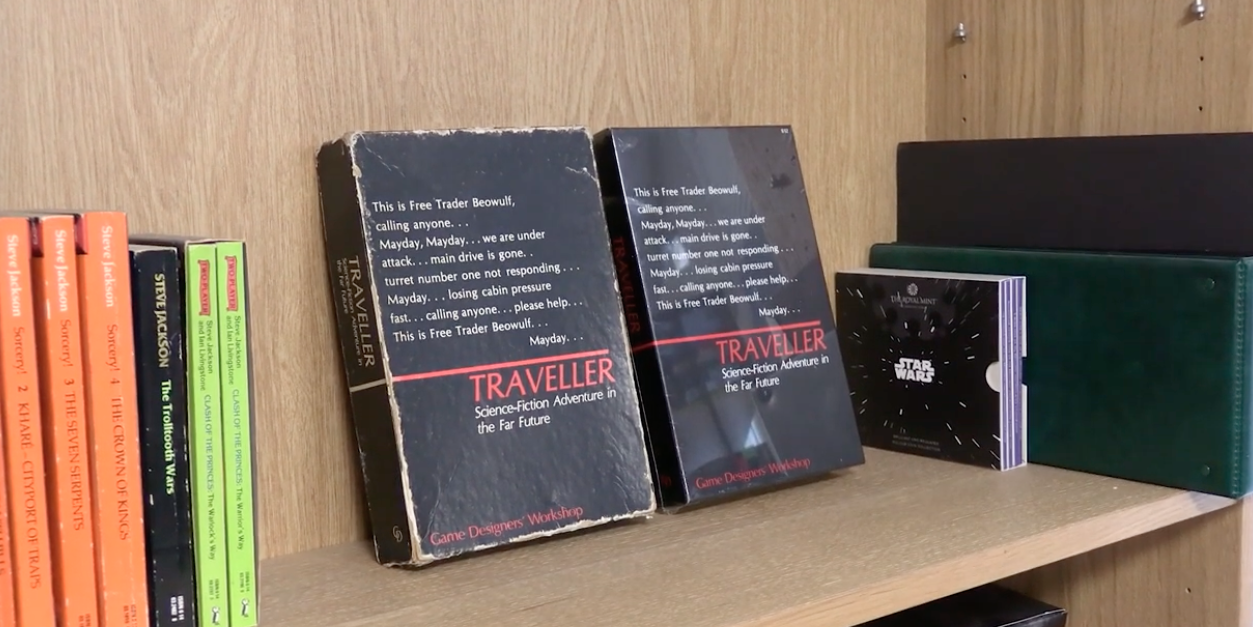
Their biggest line is Traveller, the longest running sci-fi TRPG
I turned the discussion back towards Mongoose’s history, and asked about times of struggle within the company. Matt talked about the early days and how in the early 2000s the company expanded too quickly. “We sold the Slayer’ Guides, and they’d gone well, and it occurred to our tiny little monkey brains that if we made X selling, releasing one book a month, if we did two books a month that would be 2X, and then went up to three, and then to four.” Mongoose brought in full-time writers and editors. “We didn’t know what we were doing!” ruminates Matt. “We’d never dealt with printers before, and in terms of management structure it was absolutely non-existent.” They built up to 25 employees, with no real idea what any of them were doing, each with their own self-contained projects and little oversight. Matt’s business partner at the time, Alex Fenell, left the company, and Matt struggled filling both roles. “He was always the face-man, and I’m not a face person at all.” The company suffered financially. “At one point we ran up debts of over a million pounds.” Mongoose worked through those hurdles, paid off the debts, and slowly learned the hard way how to run a company.
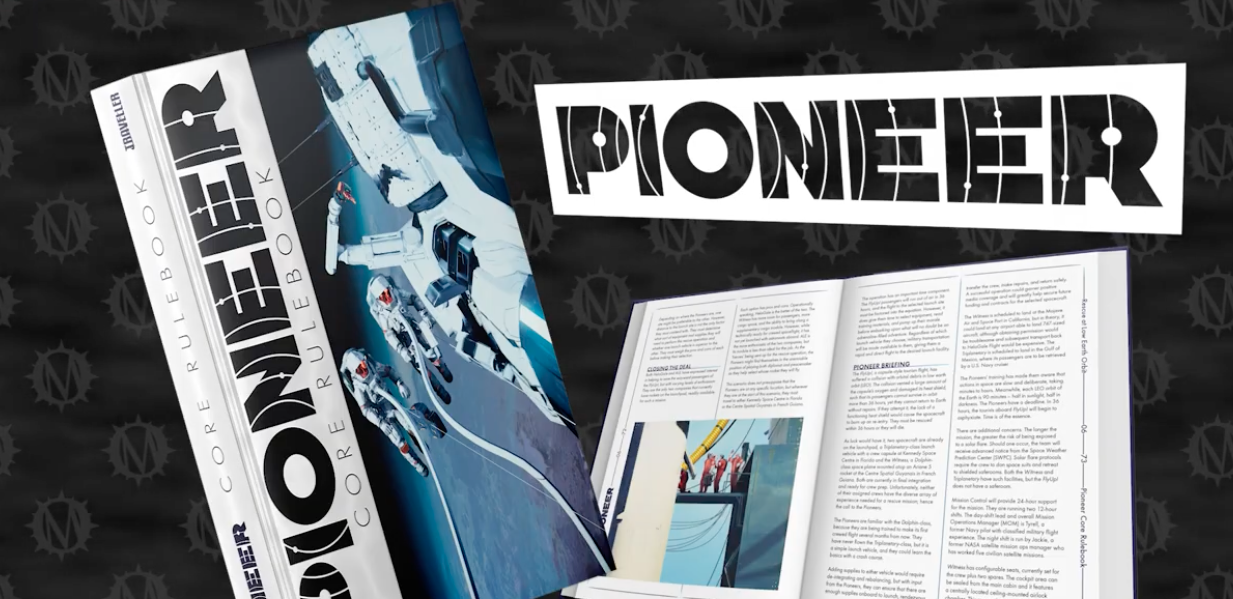
Today, Mongoose is a company with a bright future. They have several IPs which they now own in-house (and, indeed will own collectively), which Sprange feels is vital in an industry slowly being overtaken by AI. There are plans to expand the office upwards; Matt told me that “Bella and Chris already pitched [the top floor] as the Writer’s Eerie”. And a brand new Traveller-powered game of space exploration called Pioneer is on the horizon, having recently successfully crowdfunded; indeed, I was one of the backers. And there’s a secret project coming, which they couldn’t tell us about, but I’m sure we’ll all hear about it soon!
Read more at this site