

April 1983, and the new version of the magazine is in full swing. Ian Livingstone muses that while Sci-fi films are more popular than fantasy, fantasy games seem more popular than sci-fi ones. I suspect that might still be the case with Sci-fi (and superheroes) dominating the box office but Dungeons and Dragons and Pathfinder dominating the hobby space, although Game of Throne is still doing well. That’s not to say we’ve not have plenty of both. These days we are in a golden age of sci-fi and fantasy film and TV and roleplaying is both vast and popular. Nevertheless, fantasy generally remains the most popular genre for tabletop games.
If you want to compare notes, this month’s Dragon is issue #73
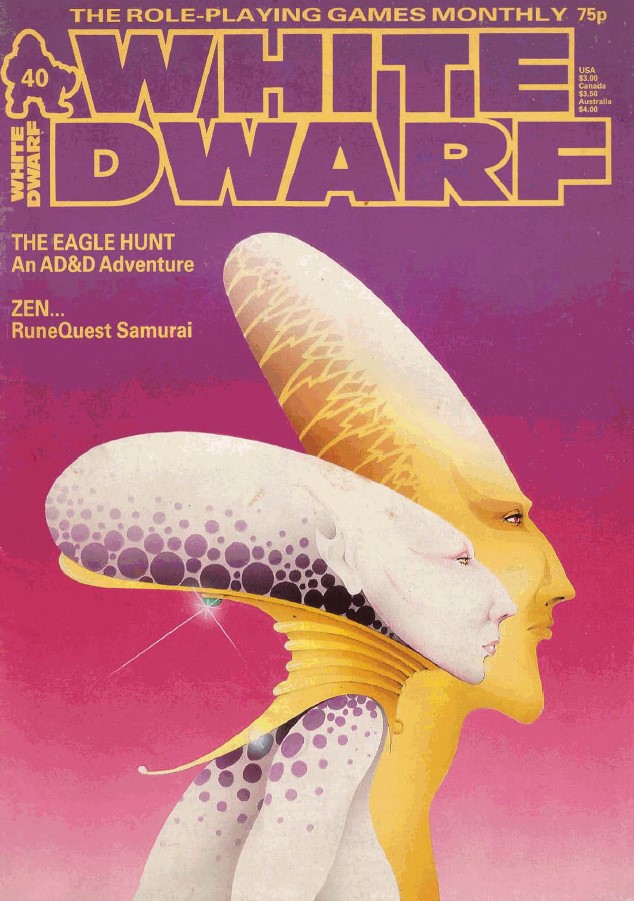
On the Cover
A long headed alien couple in profile look out across their world, all we can see of which is its pink/purple sky. It’s a simple cover but quite a haunting one with a great sense of alienness to it (probably because of the aliens). This is Emmanuel’s sixth and last cover, making him White Dwarf’s second most prolific cover artist and his style is now highly recognisable. Given his other covers were 14, 23, 25, 34 and 37 and noting this is his last it feels very much like the passing on an age. With the new logo and wide page count the magazine is now very different and Emmanuel’s covers feel like a last link with the original days of the magazine.
Features
Zen, and the Art of Adventure Gaming (Dave Morris): So it begins! The Japan/Ninja craze of the mid/late 80s that will lead to Oriental Adventures, Land of the Ninja and many others may have its seeds here (and, of course, with Bushido). It’s a good article for Runequest and covers as many rules conversion and setting notes as you could in a short article.
The Dungeon Master General (Alan E Paull): This purports to be an article on how to run battles with characters in D&D, but it’s actually a set of simple wargame rules. Very little is given to how to involve player characters in a mass battle beyond how they can help a unit attack. Then there is the maths, but that’s what gaming in the 80s was like.
The Eagle Hunt (Marcus Rowland): An interesting detective adventure, but one that treats each scene as a dungeon to be explored rather than a series of role play encounters. Still, it’s a step in the right direction and the encounters and NPCs are well put together.
Assignment: Survey! (Andy Slack): This is a great short article detailing an explorer variant of the standard Scoutship in Traveller. It offers floorplans and variant details for a more long range craft, and how you might muster out with one for your PC group. It’s small but perfectly formed and a great starting ship for a campaign of exploration into unknown worlds.
Regulars
News: A lot of this week’s news is what was previewed at the big games industry convention last month. Games Workshop is gearing up for a new release of some battle game they are calling “Warhammer”. I wonder if that will catch on. They’ll be doing figures for it too in case you were wondering. Truckstop brings 18 wheelers to Car Wars, completing the “trilogy” of the basic game with “Sunday Drivers”. There are more Fighting Fantasy books coming out, with the next one to be a sci-fi setting called “Starship Traveller” followed by the more fantasy style “City of Thieves”. There are more dungeon floor plans on the way from Games Workshop along with their answer to Car Wars: “Battlecars”. While Battlecars won’t prove any form of threat to Car Wars, another new release for the board games market called “Talisman” is coming soon, and will be popular enough to see the release of its fifth edition in 2025.
Letters: We’re back to general gripes and grumbles about the magazine, but there is still a bit of fallout from Don Turnbull’s Necromancer letter. Ok people, it’s time to move along now. There is praise for the magazine, and defences against previous criticism. Marcus Rowland pops in to correct some errata for his Slayground adventure last issue. Given Phil Masters was correcting the Javukchari not long ago this seems to be the way the magazine handles errata! There is praise for Runerites, with the reader commiserating that the rules to Runequest seem rather fluid with Wyrm’s Footnotes magazine printing copious amends and twists to them. Another reader isn’t happy with Lew Pulsipher’s Moria dungeon and spits nails over the “fact” he got the characters “wrong”, thereby missing the entire point of the article (to use well known characters as a good introduction to D&D, not to run a Tolkein game).
Critical Mass: Dave Langford looks at three new releases this month. He wades through the sixth Thomas Covenant Unbeliever book “White Gold Wielder” by Stephen Donaldson and isn’t very impressed. While we haven’t seen much recently the first trilogy was the basis for a lot of White Dwarf articles. We also take a look at the surreal time travel novel “Chekhov’s Journey” by Ian Watson which he much prefers. Finally there is “Myth Directions” by Robert Asprin which has a humour Langford is not a fan of. Given that Asprin’s Thieves World setting has an RPG supplement Langford also muses about how any of the other recent books might become RPGs. Many years later he would not be surprised to see there still isn’t a Thomas Covenant one.
Microview: It’s time to get typing into your Apple micro to create your Runequest character, the second page of this article being all the lines to type in to create your own character creation program. Yes kids, we had to type it all out and then try to save it onto a cassette in those days (shakes stick at clouds). The article also includes debugging notes and some detail that suggests it might run on other machines like a BBC micro. I imagine it was probably easier to make character by hand, but to be fair this is designed to have you ready to churn out NPC cannon fodder. I’ve not got the time or patience to try and type it into an emulator, so if anyone did, how did the programme work out?
Runerites: An interesting article this month details how to trade and embrace capitalism in your Runequest game. Using this new trading skill you can spin a story to make some money hawking your wares across Glorantha. It’s a solid system for making a buck or two and might form a good set up for a travelling campaign set up.
Starbase: No Starbase this month, I think its alternating with Microview. So I don’t know why the exploration scourtship wasn’t done under the banner of Starbase. It’s basically just a slightly longer than usual Starbase article.
Treasure Chest: We’re back to the usual fare of a selection of magic items this month. We have six offerings. The Arrow of the Inner Planes that can hit ethereal creatures, but only ethereal creatures. The Druid’s Flask that creates potions after being ritually charged in the right way. My favourite, the Cloth of the Wind Horse is a small handkerchief that can turn into a spectral horse. The Shaft of the Spider is an arrow that sometimes hits the target with a web spell too. The Wand of Locking lets the wizard lock his door when he leaves his laboratory. Then there is the Wizard’s Wand that allows the Magic User to cast spells directly from their spell book.
Fiend Factory:
Inhuman Gods Part I (Phil Masters): We continue with Phil Master’s series on the gods of monsters. In this article we look at the gods of: Firenewts, Flinds, Flymen (WD#23) and Frog Folk. I don’t think any of us were waiting with baited breath for this essential collection. But it’s a solid selection of interesting new mega villain monsters.
Open Box
This month’s reviews are:
- Soloquest 2: Scorpion Hall, Runequest Solo Adventures (Chaosium) A follow up solo adventure to the Snow King’s Bride and a pretty decent offering according to Oliver Dickinson.
- Dungeon Modules: C1 The Hidden Shrine of Tamoachan (1981 edition), C2 The Ghost Tower of Inverness, S2 White Plume Mountain (1981 edition), I1 Dwellers of the Forbidden City, D&D Adventures (TSR Inc) What a pile of classics! I doubt anyone hasn’t at least played White Plume Mountain, and it’s even had an official 5e revision. I played the hell out of Ghost Tower many years ago, running it copious times for several different groups at school. Hidden Shrine is also a renowned classic, but Dwellers doesn’t impress here and won’t reach classic status. While both White Plume Mountain and Hidden Shrine were published much earlier, these editions give them the same colour cover as the current releases.
- Illuminati, Card/Board game (Steve Jackson Games) The first edition of one of Steve Jacksons more popular games. This version will see three expansions and it will get multiple new editions. The most recent supplement releasing in 2020. Like Talisman, this is one of the longest running games out there, certainly in the family market.
- Starstone, Generic fantasy adventures (Northern Sages) These three linked adventures for any fantasy game were written by Paul Vernon who wrote the excellent Town and City planner articles for White Dwarf issues 29 to 33 and “Trouble at Embertrees” (WD#34) an adventure set in the Starstone world. He would go on to write for Warhammer Fantasy Roleplay and might be the same Paul Vernon now working on art and graphics for video games.
Read more at this site