

Despite hours spent scrolling through digital tools and PDFs, the nuances of the new system felt slippery, like trying to catch smoke with my hands. It wasn’t until I brought the game back to the physical table—specifically during my weekly sessions at the local library—that the culprit revealed itself.
Reading comprehension on a screen is a fundamentally different beast than engaging with a physical book. The passive scanning we do online might help us find a quick stat, but it fails to build the deep, structural understanding required to run a complex game. This realization has fundamentally changed how I prep, leading me to advocate for a return to the paper-and-ink roots of the hobby.
The Spatial Power of the Page
The primary advantage of a physical book lies in its ability to engage our spatial and kinesthetic memory. When you hold a Player’s Handbook, your brain isn’t just recording text; it’s building a three-dimensional map of information. You begin to remember that the Grappled condition is “near the back, top left corner,” or that the weapon mastery table is about a third of the way through the volume. This sense of physical progress—the thickness of the pages in your left hand versus your right—creates anchors that digital scrolling completely lacks.
At the library, I’ve asked them to keep multiple physical copies on hand for this very reason. Watching a new player’s eyes light up as they physically flip to a rule and “own” that location on the page is a testament to how our brains are wired to learn through geography and touch. It’s also been educational for my players, who don’t know the rules nearly as well as they thought, or have no idea where a rule is for explication because they’ve only ever referenced the books online.
Cognitive Depth and Intentional Reference
We are currently battling what researchers call the Screen Inferiority Effect, where comprehension and retention drop significantly when we read from a monitor. Digital tools like D&D Beyond are fantastic for speed, but they encourage a shallow, “skim-first” mentality that bypasses deep processing.
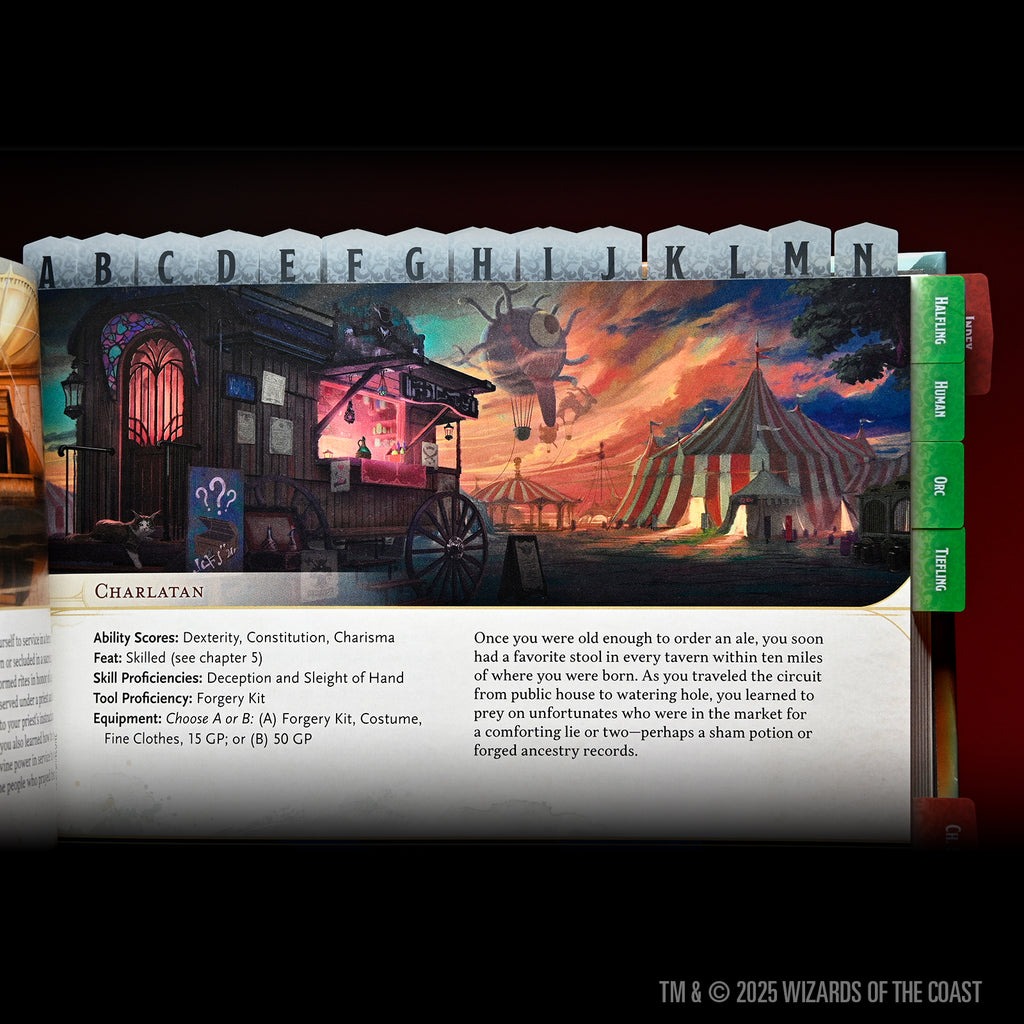
To combat this in my own 2024 core books, I’ve invested heavily in making the reference process more intentional and tactile through the use of thumb-indexes. I’m particularly partial to the WizKids 2024 Player’s Handbook Tabs, the Dungeon Master’s Guide Tabs, and the Monster Manual Tabs. These physical markers transform the book into a high-speed tool, requiring a deliberate physical action to find a rule. That extra second of effort—the reach, the flip, the find—forces the brain to be more intentional, turning a fleeting search into a lasting memory. At least for me, this means I actually remember the rules and where they are in the context of other rules — a huge advantage when dealing with new players asking me multiple questions at the table in real time.
Tactile Learning and the Human Connection
Beyond simple reading, the in-person environment provides a multisensory experience that reinforces the rules through constant action. When you play online, a computer often handles the math, leading to a passive engagement where you click a button and wait for the result. In-person, you are physically computing bonuses, tracking spell slots with a pencil, and hearing the literal clatter of dice on the table. It takes about two hours to make a character, but I think the learning experience is worth it.
These sensory inputs—the smell of the paper, the sound of the pages, and even the non-verbal cues from your players—create an emotional context that strengthens recall. When a player at the library argues a rule or celebrates a crit, that moment is anchored by the shared physical environment. This “emotional memory” is the glue that makes the rules stick, turning a dry mechanic into a lived experience that no digital interface can truly replicate.
Back to the Source
While digital tools have their place for quick lookups in the heat of a session, I consider them the supplement, not the source. The depth and retention I’ve seen at the library and in my own game room prove that the physicality of the 2024 edition matters a lot. By embracing the weight of the books, the precision of thumb-indexes, and the multisensory chaos of a live table, we aren’t just playing a game; we are mastering a craft. It’s more work to flip the pages, but the knowledge we gain is a treasure that stays with us long after the session ends.
Your Turn: Do you find you retain rules better when the manual is in front of you?
Read more at this site