

Managing a table of ten players is less like storytelling and more like air traffic control. In the heat of my weekly library sessions, the biggest threat to immersion isn’t the monsters; it’s the dead air that creeps in when players lose track of the turn order. When a round takes twenty minutes to complete, engagement withers. I’ve tried various digital trackers and scribbled lists, but in a crowded, high-energy environment, those solutions are often too small to see or too cumbersome to manage. I realized I needed a high-visibility, physical anchor that would allow every player to see exactly where they stood in the timeline without having to ask me. And that got me thinking … surely there are other situations where the number at your table has to be visible for confused folks in a large group, right?
From Dragons to Numbers
Wedding table cards. That was the answer. My journey toward a better tracker started with a set of decorative wedding table cards featuring dragons. They were beautiful and felt right for the genre, but they were made of heavy metal and proved far too burdensome to lug to the library every week. More importantly, most wedding sets don’t account for the chaotic reality of a D&D initiative count that can easily climb into the twenties. I needed something lightweight, durable, and highly visible from across a long library table.
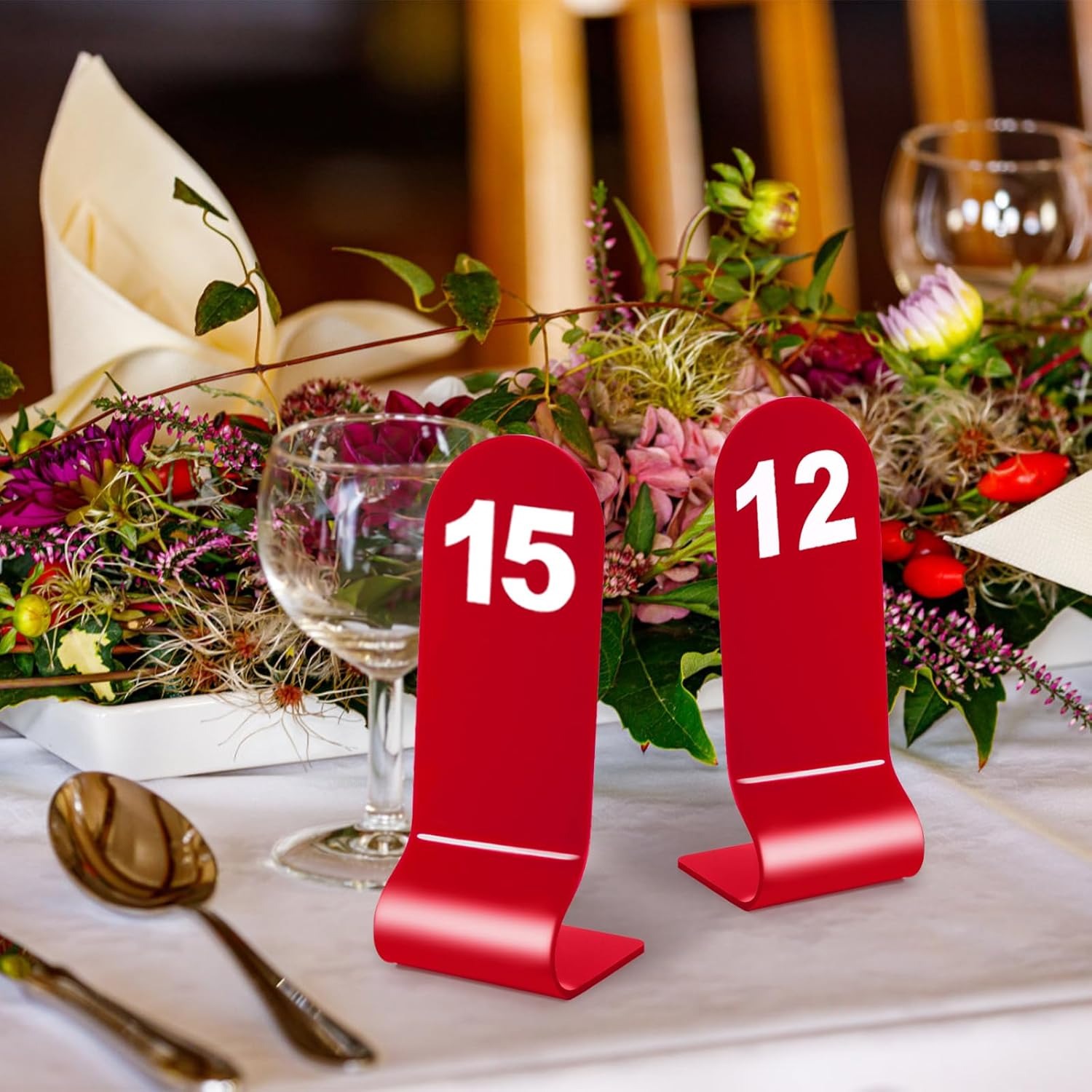
I eventually discovered a set of red and white numbered table cards that go all the way up to thirty. These cards are tall enough to stand out over piles of character sheets and dice trays, and because they are double-sided, the players can see each other’s numbers just as clearly as I can. Placing these in front of the players creates an instant, undeniable map of the round.
Orchestrating the Round
With the cards providing the visual foundation, I’ve been able to implement a “system of speed” that keeps the Hammersmith campaign moving. The most effective technique is the “on deck” announcement. By explicitly telling a player they are currently acting while informing the next person they are next, we reduce the frantic searching for dice or spells that usually happens when a turn begins.
Because the red cards are so visible, the players have started to self-manage this process. If I accidentally skip someone or if a player isn’t ready, the physical presence of that numbered card acts as a silent reminder. Add in that two PCs have familiars with their own initiative, and this becomes even more important.
To further streamline the engine, I’ve moved toward group initiative for my monsters and—if it’s a really big group, though I do this rarely—use average damage values from the stat blocks. This ensures that my side of the table never bogs down the narrative, allowing the focus to remain on the players’ heroic (if occasionally disastrous) choices.
The Captain and the Clock
In a group of seven or more players, a Dungeon Master cannot be the only person responsible for the logistics of the game. In the older rules there was someone who called initiative on behalf of the group, a “caller.” This person is responsible for calling out the order and ensuring everyone is focused. I have yet to use this (given my group rotates frequently, there’s no clear leader week to week) but I can see doing it if the group gets chaotic enough.
I also have as a backstop the “thirty-second rule” for turns, though this doesn’t happen often; if a player hasn’t declared an action in that window, their character automatically takes the Dodge action. To keep the focus sharp, we ask for a no-phones policy, ensuring that the only screen in the room is the collective imagination of the group, but acnkowledge in large groups, sitting around isn’t fun either so I try to be flexible.
Why Visibility Wins
Ultimately, the wedding card solution works because it respects the spatial and tactile nature of in-person play. By giving the initiative order a physical, three-dimensional presence on the table, I’ve reduced the cognitive load on both myself and my players. We no longer spend time asking “Who is next?” or “Where are we in the round?” Like a wedding, everyone knows whose turn it is in the party.
Your Turn: How do you handle initiative for large groups?
Read more at this site